
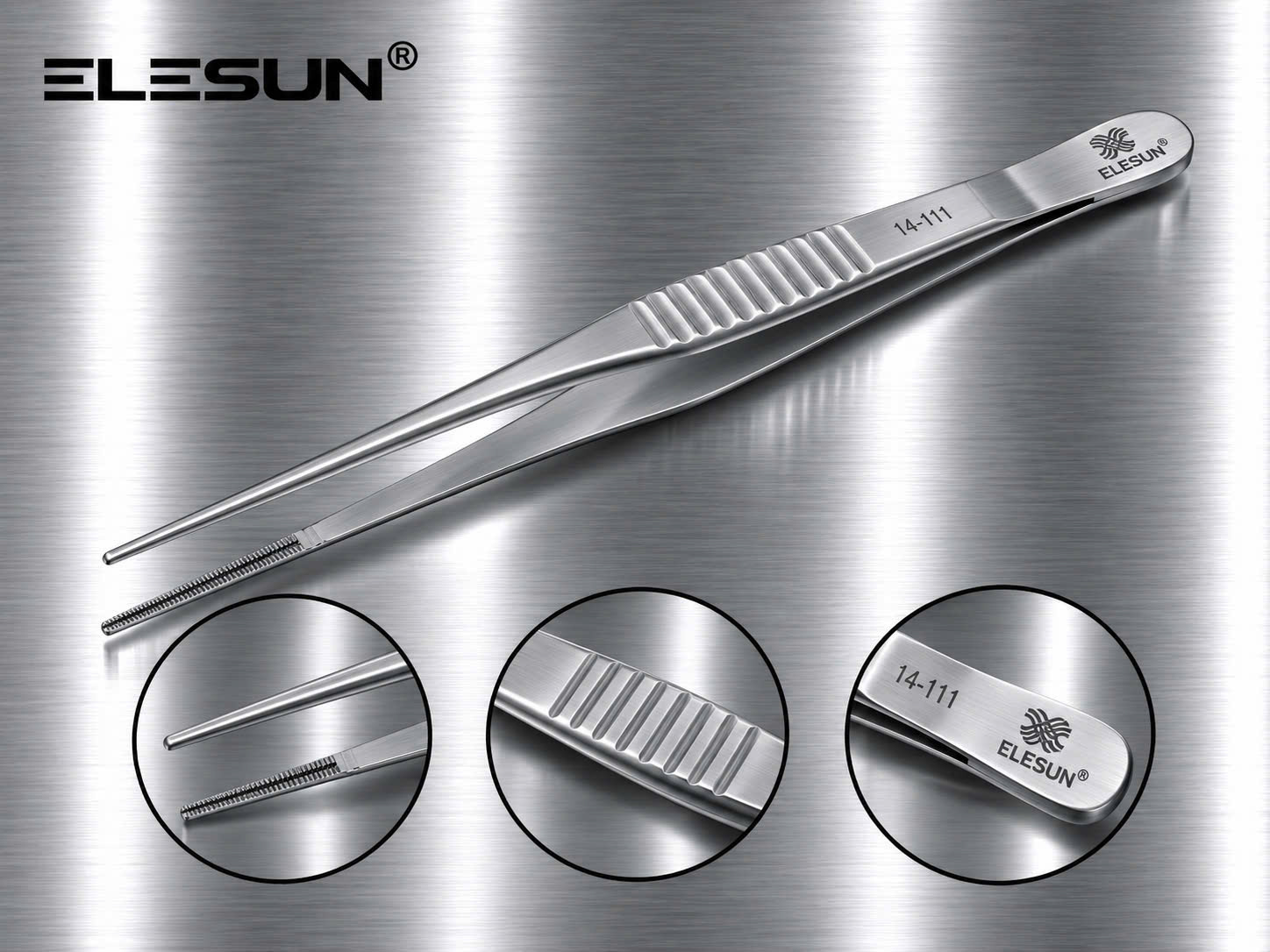
Vascular dissecting forceps are hand-held spring forceps used to hold the vessel wall and perivascular tissue during dissection and anastomosis. This guide analyzes DeBakey-pattern forceps: tip geometry, serration patterns, shaft configuration, working length and the technical criteria for selection.
1. What Are Vascular Dissecting Forceps?
Vascular dissecting forceps (also called vascular tissue forceps) are hand-held instruments with two limbs joined at the proximal end; they close under finger pressure and spring open through the elasticity of the shanks. They are used to hold the vessel wall, adventitia and perivascular tissue during dissection, clamp placement and anastomosis. DeBakey forceps are the most widely used configuration of this group in cardiovascular and vascular surgery.
This guide expands on the forceps section of the vascular surgical instruments overview and complements the guide to vascular clamps: Satinsky, Bulldog and specialized designs. It is professional knowledge and does not replace the manufacturer's instructions for use (IFU) or the surgeon's judgment.
2. DeBakey-Pattern Forceps: Origin & Defining Features
Many cardiovascular and vascular instruments carry the names of surgeons who designed them in response to specific clinical needs, as reviewed by Ailawadi and colleagues (2010) in their history of cardiothoracic surgical instruments. DeBakey forceps are a classic example.
According to a review by Salehi (2024), the defining features of the DeBakey pattern are:
- Small serrations along the jaws: designed to spread grasping pressure across many contact points to limit tissue injury.
- Long shanks and fine working tips: for reaching deep operative fields.
- A grooved or ribbed grip area: to support control during handling.
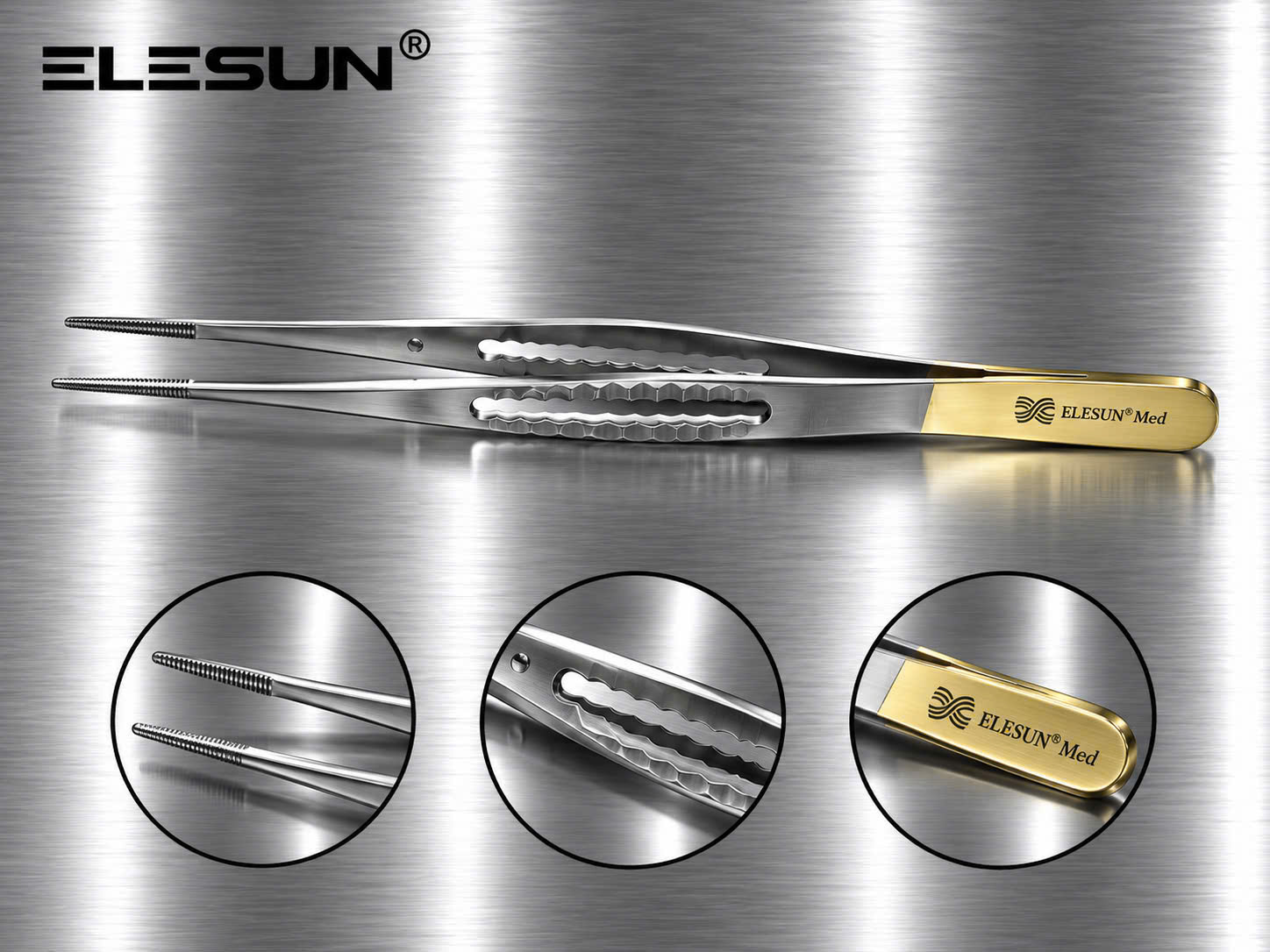
In the ELESUN catalog, the DeBakey vascular tissue forceps have fenestrated shanks; according to the product data, the gold-colored handle end is the convention identifying the tungsten carbide (TC) jaw configuration of this model.
3. Working-Tip Geometry
The working tips are the part in direct contact with the vessel wall. When comparing vascular dissecting forceps, four geometric features matter:
- Tip width: narrow tips reach small tissue planes and small vessels; wider tips spread force over a larger area when holding a large vessel wall.
- Length of the serrated area: determines how much tissue is actually held between the jaws.
- Tip shape: straight, curved or angled relative to the shaft axis, chosen by direction of approach.
- Tip alignment: both tips must meet at the same point without offset or crossing on closure.
4. Serration Patterns & Differences From General Tissue Forceps
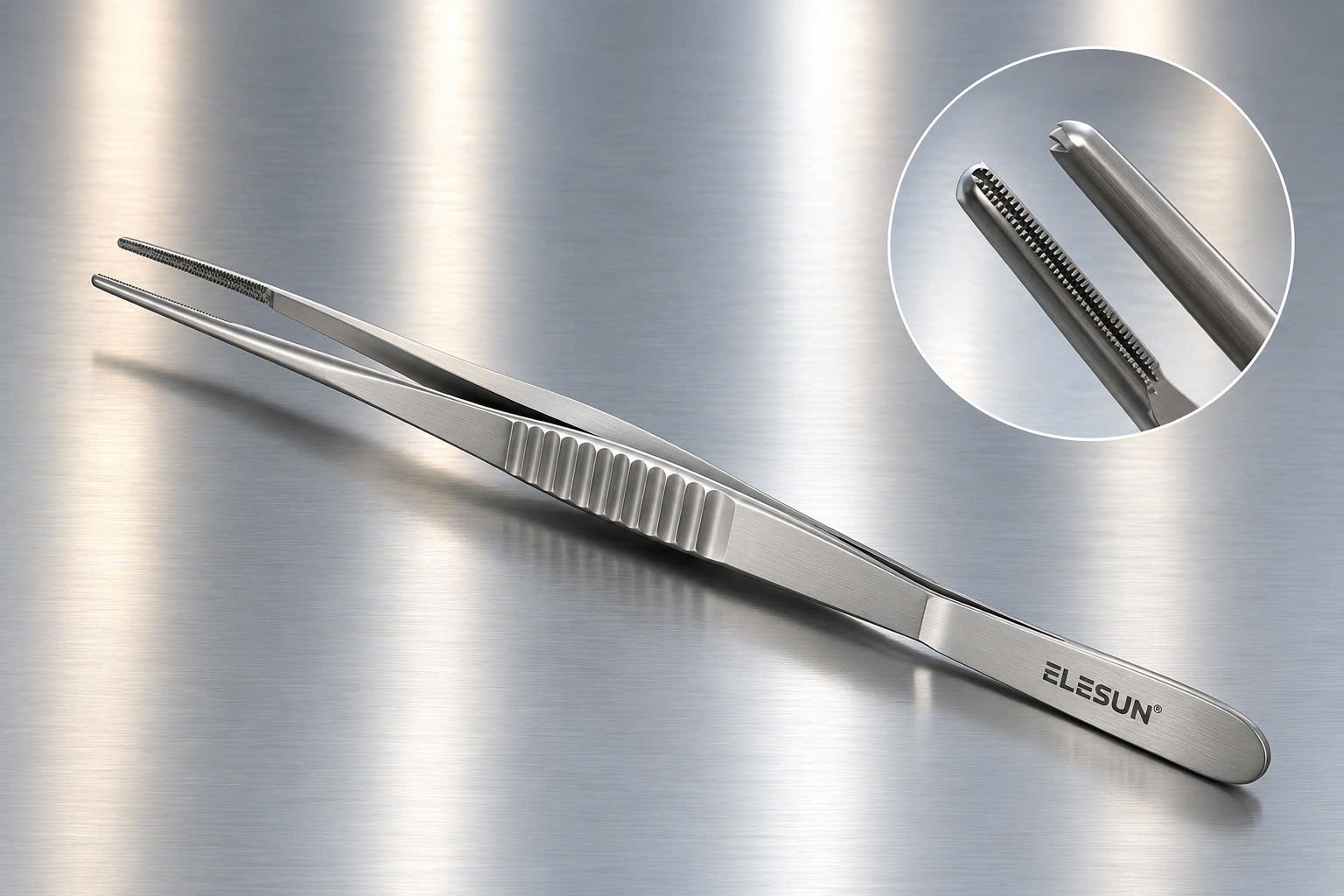
The serration pattern determines how grasping force reaches the tissue. Common design groups for dissecting forceps include:
- Fine rows of teeth along the jaw (DeBakey pattern): small teeth distributed along the jaw length to divide grasping force across many points.
- Transverse serrations: grooves perpendicular to the jaw axis that increase friction when holding tissue or material.
- Toothed tips: hold tissue more firmly; whether they are used on the vessel wall depends on the manufacturer's stated intended use and the surgeon's judgment.
- Smooth tips: no serrations, used for thin tissue or suture handling according to the manufacturer's design.
Tooth density, depth and serrated length vary between models. These are specifications to read in the manufacturer's documentation, not to infer from an instrument's generic name.
Compared with general tissue forceps used for soft tissue at large, DeBakey-pattern vascular forceps differ in three ways: the jaws use fine rows of teeth along their length rather than transverse grooves or toothed tips, the shanks are usually longer to reach deep fields, and the tips are fine for holding the vessel wall and perivascular tissue. General tissue forceps keep their own role; which group to use depends on the tissue and the manufacturer's stated intended use.
5. Straight & Angled Shafts, Shaft Length & Access
Most vascular dissecting forceps have straight shafts, but some designs have curved or angled tips to reach structures off the shaft axis. Overall length determines reach: longer forceps suit deep operative fields, while shorter forceps give better control in superficial fields. General principles of straight, curved and angled geometry and working length are analyzed in the surgical instrument selection and design principles guide.
The shank design also affects handling: fenestrated shanks, as on the DeBakey model above, or a transversely ribbed grip improve finger purchase. Spring tension should be just enough for the tips to open by themselves without tiring the hand quickly.
6. Atraumatic Design Principles
DeBakey-pattern forceps are commonly called atraumatic forceps. The term describes a design intent — spreading grasping force to limit injury — not a guarantee that tissue is entirely unaffected. The actual effect also depends on finger pressure, grasping time, tissue condition and the condition of the tips (worn serrations or misaligned tips can change how force is distributed).
This article gives no recommendations on tissue-handling technique. Instrument choice and handling remain the surgeon's professional judgment and the manufacturer's stated intended use.
7. Comparison With Related Forceps
DeBakey forceps are often compared with fine-pointed dissecting forceps and spring-handled micro forceps. The table summarizes the main mechanical differences:
| Feature | DeBakey-pattern forceps | Fine-pointed dissecting forceps | Spring-handled micro forceps |
|---|---|---|---|
| Working tips | Fine, with small teeth along the jaw | Very sharp, small contact area | Ultra-fine, used under magnification |
| Overall size | Long shanks for deep fields | Varies by model | Handle held in a pencil grip |
| Main purpose | Holding the vessel wall and perivascular tissue | Precise handling of small structures | Handling small vessels and micro sutures |
| Key inspection points | Intact serrations, tips aligned | Points not bent, tips meet exactly | Tips undeformed, even spring tension |
The structure and geometry of micro forceps are analyzed in detail in the microsurgical forceps guide.
8. Selection Criteria & Technical Inspection
- Length for field depth: enough reach while preserving control.
- Tip width for vessel size: narrow tips for small vessels, wider tips for large vessel walls.
- Serration pattern: suited to the manufacturer's stated intended use.
- Straight or angled shaft: according to the intended approach.
- Pre-purchase evaluation: request samples so surgeons can assess handling, spring tension and tip alignment, and check the IFU against the central sterile services department's capabilities.
- Materials and IFU: declared shank and jaw materials, and reprocessing information under ISO 17664-1. See also the surgical instrument materials and technical standards guide.
After each reprocessing cycle, check that the tips meet exactly without crossing, the serrations are intact and free of residue, the shanks are not bent, and spring tension is even in both limbs. Cleaning and sterilization principles are summarized in the surgical instrument reprocessing, cleaning and sterilization guide.
For cleaning, disinfection, and sterilization, follow the applicable manufacturer's IFU and the healthcare facility's validated reprocessing procedures.
9. Frequently Asked Questions
How do DeBakey forceps differ from standard dissecting forceps?
The main differences are the jaws and the size. According to a review by Salehi (2024), DeBakey-pattern forceps have small serrations along the jaws, designed to spread grasping pressure across many contact points, together with long shanks and fine tips for reaching deep fields. Standard dissecting forceps may use transverse serrations, toothed tips or smooth tips, serving different tissue-handling purposes.
Are "atraumatic" forceps completely harmless to tissue?
No. "Atraumatic" describes a jaw design intended to spread force and limit injury; it does not guarantee that tissue is entirely unaffected. The actual effect also depends on finger pressure, grasping time, tissue condition and the condition of the tips. Worn serrations or misaligned tips can change how force is distributed, which is why regular inspection matters.
How should the length of vascular dissecting forceps be chosen?
Length should match the depth of the operative field. Longer forceps let the tips reach deep structures while the hand stays outside the line of sight; shorter forceps give better control in superficial fields. A vascular set usually includes several lengths so the surgeon can choose according to the anatomical site and the specific approach.
How do DeBakey forceps differ from microsurgical forceps?
DeBakey forceps are long-shank tissue forceps used to hold the vessel wall and perivascular tissue in conventional vascular surgery. Microsurgical forceps have spring handles held in a pencil grip and ultra-fine tips, used for small vessels and micro sutures under loupes or a microscope. The two groups differ in tip size, grip and scope of use.
What does a gold-colored handle end on dissecting forceps mean?
For the DeBakey vascular tissue forceps in the ELESUN catalog, the product data confirms that the gold-colored handle end is the convention identifying a tungsten carbide (TC) jaw configuration. Color conventions can differ between manufacturers and instrument lines. Color is not a substitute for specifications, however; the configuration of each instrument code should be confirmed from the manufacturer's technical documentation.
What should be checked on vascular dissecting forceps after each reprocessing cycle?
Typical checks are: the tips meet exactly without crossing or offset; serrations are intact, unchipped and free of residue; the shanks are not bent; spring tension is even in both limbs; and surfaces show no corrosion or cracks. Cleaning, disinfection and sterilization must follow each instrument's IFU and the facility's validated reprocessing procedures.
10. Conclusion
DeBakey-pattern vascular dissecting forceps are identified by fine rows of teeth along the jaws, long shanks and fine working tips. Appropriate selection rests on length for field depth, tip width, serration pattern, shaft configuration and the manufacturer's documentation; regular inspection of tips and serrations helps maintain the instrument's gripping characteristics.
Consult ELESUN on Vascular Forceps
Explore the vascular dissecting forceps in our catalog and surgical solutions supported by ELESUN technical specialists.
Related articles in the vascular instruments series
References
- Salehi S. (2024). The Impact of DeBakey Forceps on Cardiac Surgery: Revolutionizing the Surgical Landscape. Cureus, 16(6):e63121 (PMC11271757).
- Ailawadi G., Nagji AS., Jones DR. (2010). The legends behind cardiothoracic surgical instruments. The Annals of Thoracic Surgery, 89(5):1693–1700.
- ISO 17664-1:2021. Processing of health care products — Information to be provided by the medical device manufacturer for the processing of medical devices — Part 1: Critical and semi-critical medical devices.