
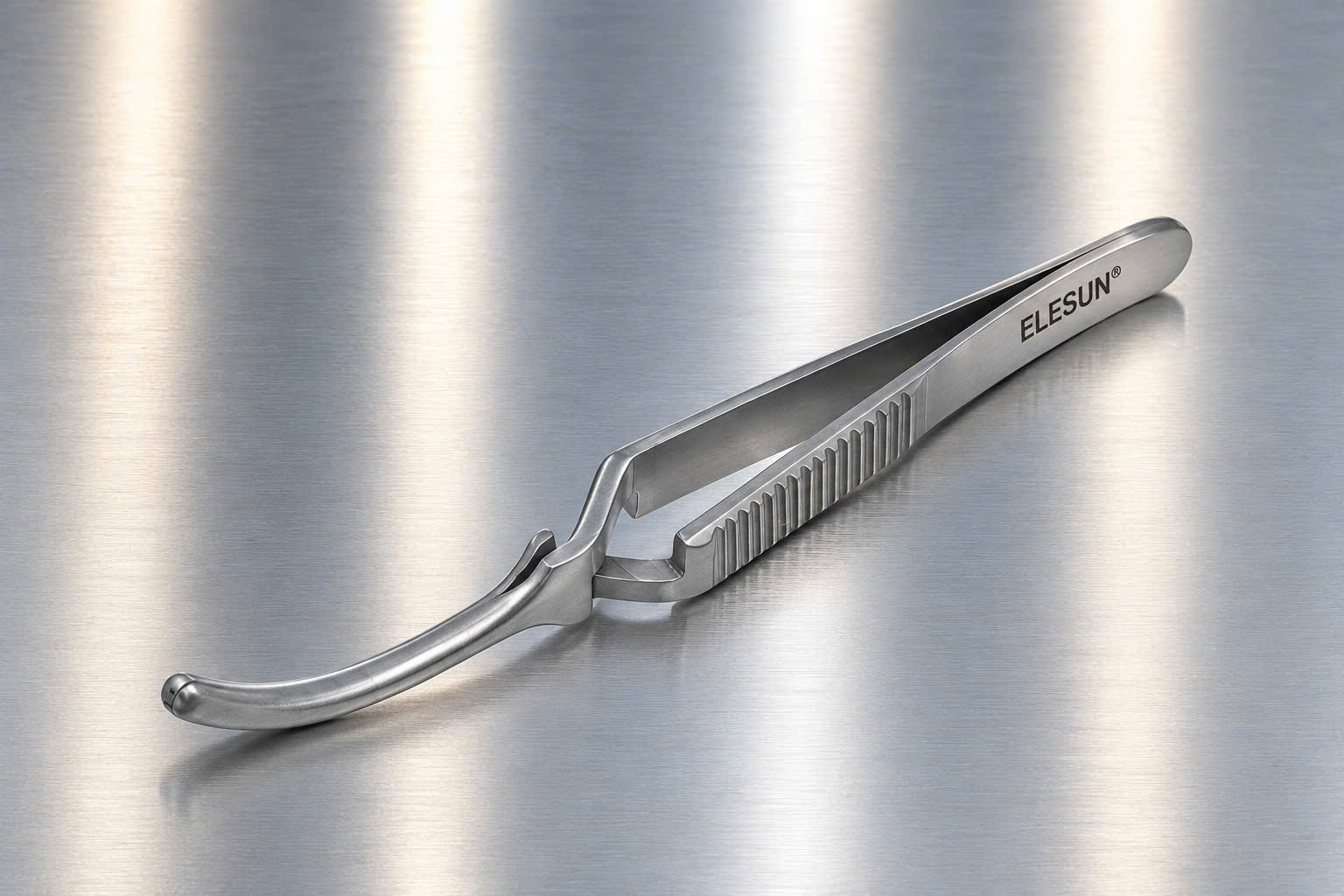
A vascular clamp is a mechanical instrument used to temporarily occlude all or part of the flow within a vessel. This guide explains vascular clamping principles, how Satinsky, Bulldog and long-shank angled clamps differ, jaw geometry, ratchet versus spring mechanisms, and selection criteria.
1. What Is a Vascular Clamp?
A vascular clamp is a mechanical surgical instrument that closes two jaws on the vessel wall to temporarily occlude flow, fully or partially, while the surgeon opens, anastomoses or repairs the vessel. Unlike a general hemostatic forceps, a vascular clamp is designed for a vessel segment that must keep functioning after the clamp is removed, so jaw geometry and clamping force are the two central parameters.
This guide expands on the clamp section of the vascular surgical instruments overview: clamping principles, Satinsky, Bulldog and long-shank angled configurations, locking mechanisms and selection criteria. It is professional knowledge and does not replace the manufacturer's instructions for use (IFU) or the surgeon's judgment.
2. Clamping Principles: Clamping Force & the Vessel Wall
To stop flow, the jaw force must overcome the pressure inside the vessel. An experimental study on rat abdominal aortas by Sun and colleagues (2021) derived a formula for the minimum occlusive force from three variables: vessel diameter, blood pressure and clamp jaw width; measured forces did not differ significantly from the calculated values.
Clamping force and duration also relate to the effect on the vessel wall. A computational model by Chen and colleagues (2010) showed that the shape of the jaw contact surface substantially changes the stress on the vessel wall, particularly on the luminal side. In a porcine aortic model, Babin-Ebell and colleagues (2010) observed endothelial damage even with moderate clamp application, with clamp duration having a clearer influence than intra-aortic pressure.
These findings come from experimental and computational models. They explain why jaw geometry and clamping force matter, but they are not clinical instructions. Clamp choice, ratchet position and clamping time remain the surgeon's professional judgment.
3. Total Versus Partial Vascular Occlusion
By how the jaws engage the vessel, vascular clamps fall into two functional groups:
- Total occlusion clamps: the jaws cross the full vessel diameter and stop all flow through the clamp site. Bulldog clamps and most straight or angled clamps applied across the vessel axis work this way.
- Partial occlusion (tangential) clamps: curved jaws engage only part of the vessel wall, isolating a working area while the remaining lumen can continue to carry flow. The Satinsky clamp is the typical example.
The choice between the two depends on vessel size, the working site and the operative plan, and is made by the surgeon.
4. Satinsky & Side-Biting Clamps
The Satinsky clamp is a side-biting (tangential) clamp with finger-ring handles, a multi-position ratchet and S- or C-curved jaws. The jaw curvature lets it take part of the wall of a large vessel, creating a working area for a suture line on the vessel side. When evaluating a Satinsky clamp, consider jaw curve radius, contact length, serration pattern and how evenly the jaws meet along their full length at each ratchet position.
See the Satinsky tangential vascular clamp with double-curved S-shaped jaws and a multi-position ratchet in the ELESUN catalog.
5. Bulldog Vascular Clamps
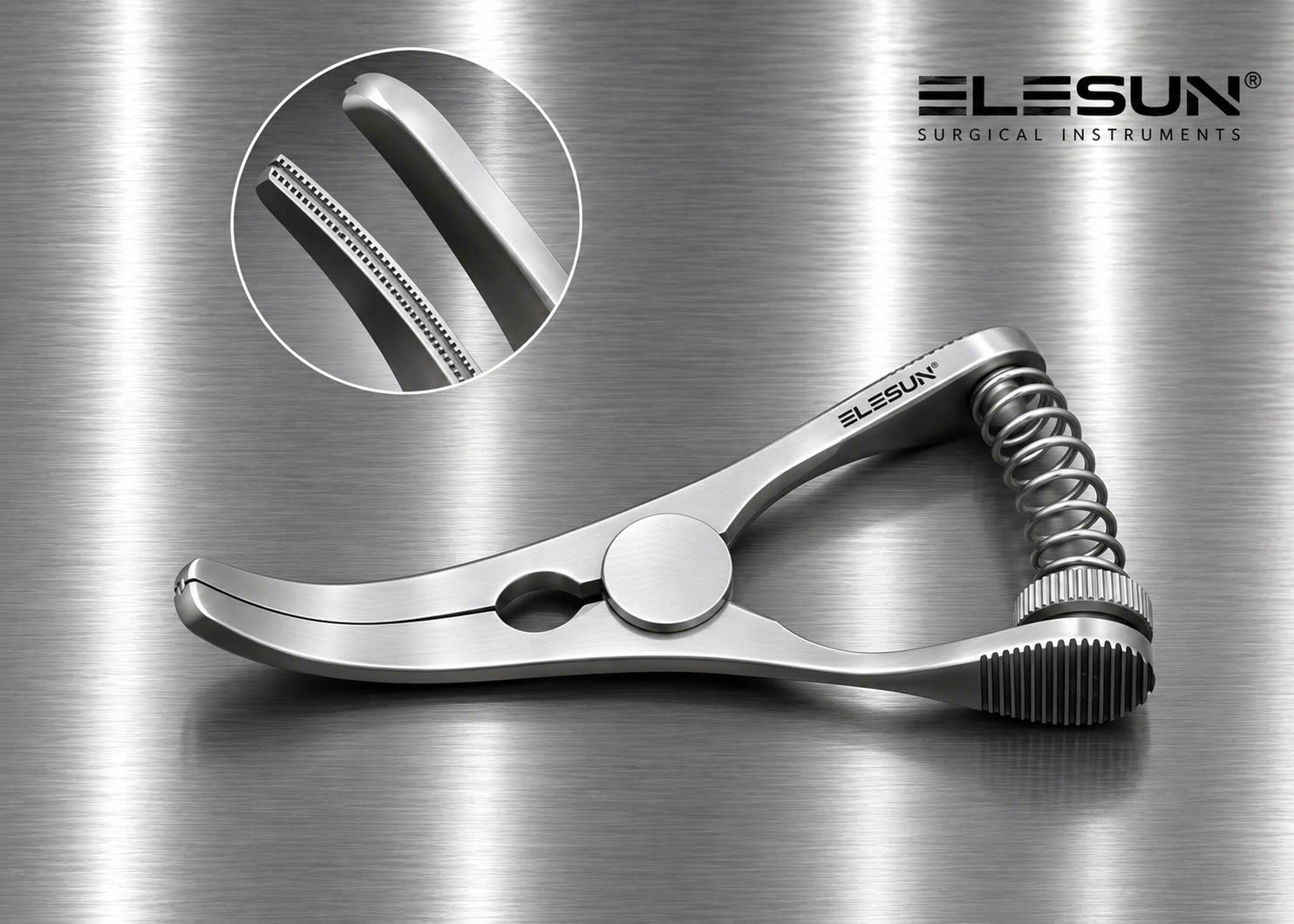
Bulldog vascular clamps are small self-retaining clamps without long handles or a ratchet: the jaws close under spring force when the surgeon releases them. The cross-action design reverses the squeeze, so pressing the finger plates opens the jaws. Their compact size lets them remain on peripheral vessels or small branches without occupying the operative field.
Because clamping force is set by the spring and cannot be adjusted step by step as with a ratchet clamp, size, jaw length and jaw shape (straight or curved) for a given vessel diameter should be chosen from the manufacturer's information. See the Bulldog vascular clamp with a cross-action spring and curved jaws.
6. Long-Shank & Angled-Jaw Clamps
In deep operative fields, or where a vessel lies behind other anatomical structures, long-shank clamps with angled jaws place the jaws across the vessel axis while the handles stay outside the line of sight. Three geometric parameters should be matched to the intended site: jaw angle, jaw length relative to vessel diameter, and shank length.
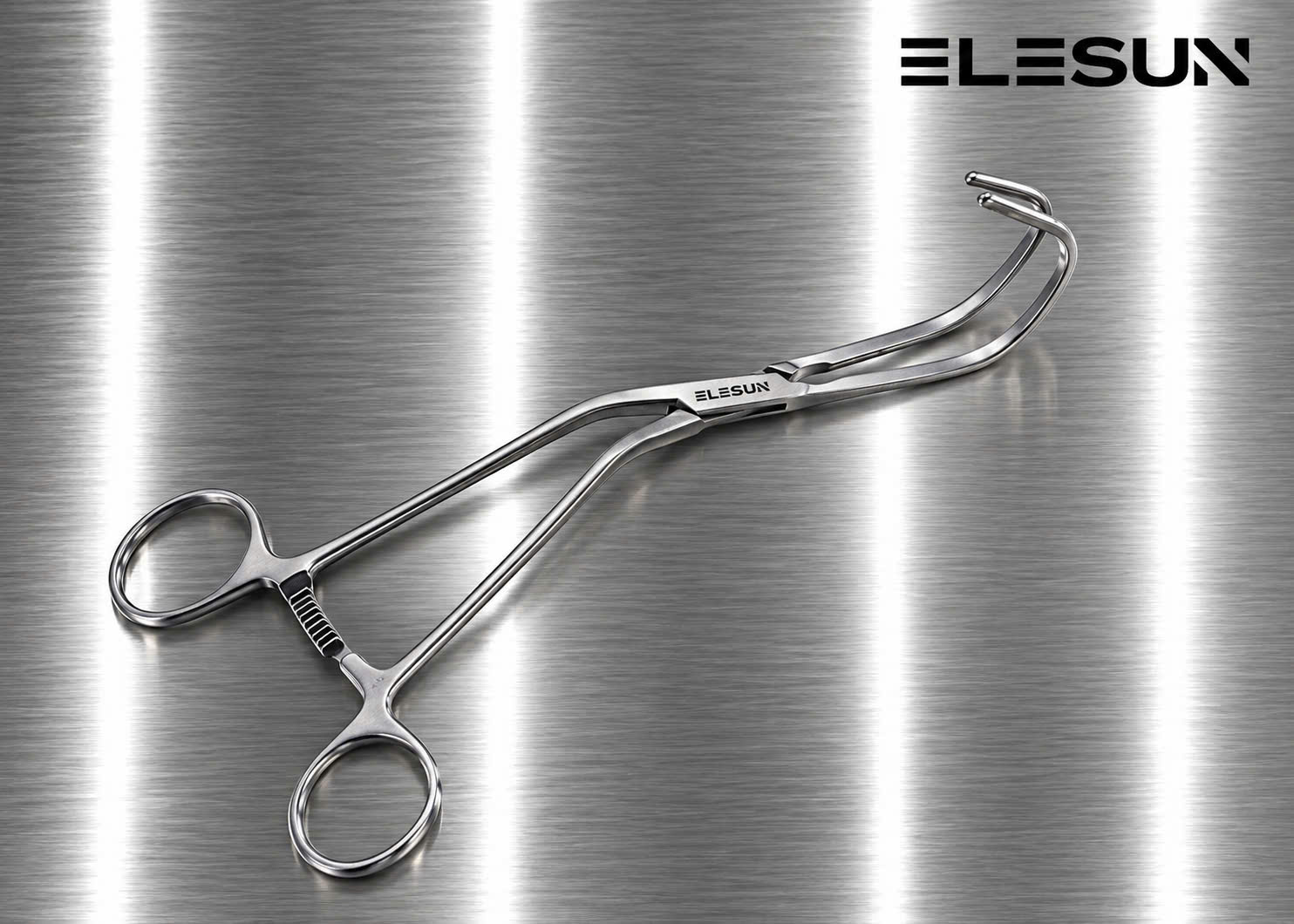
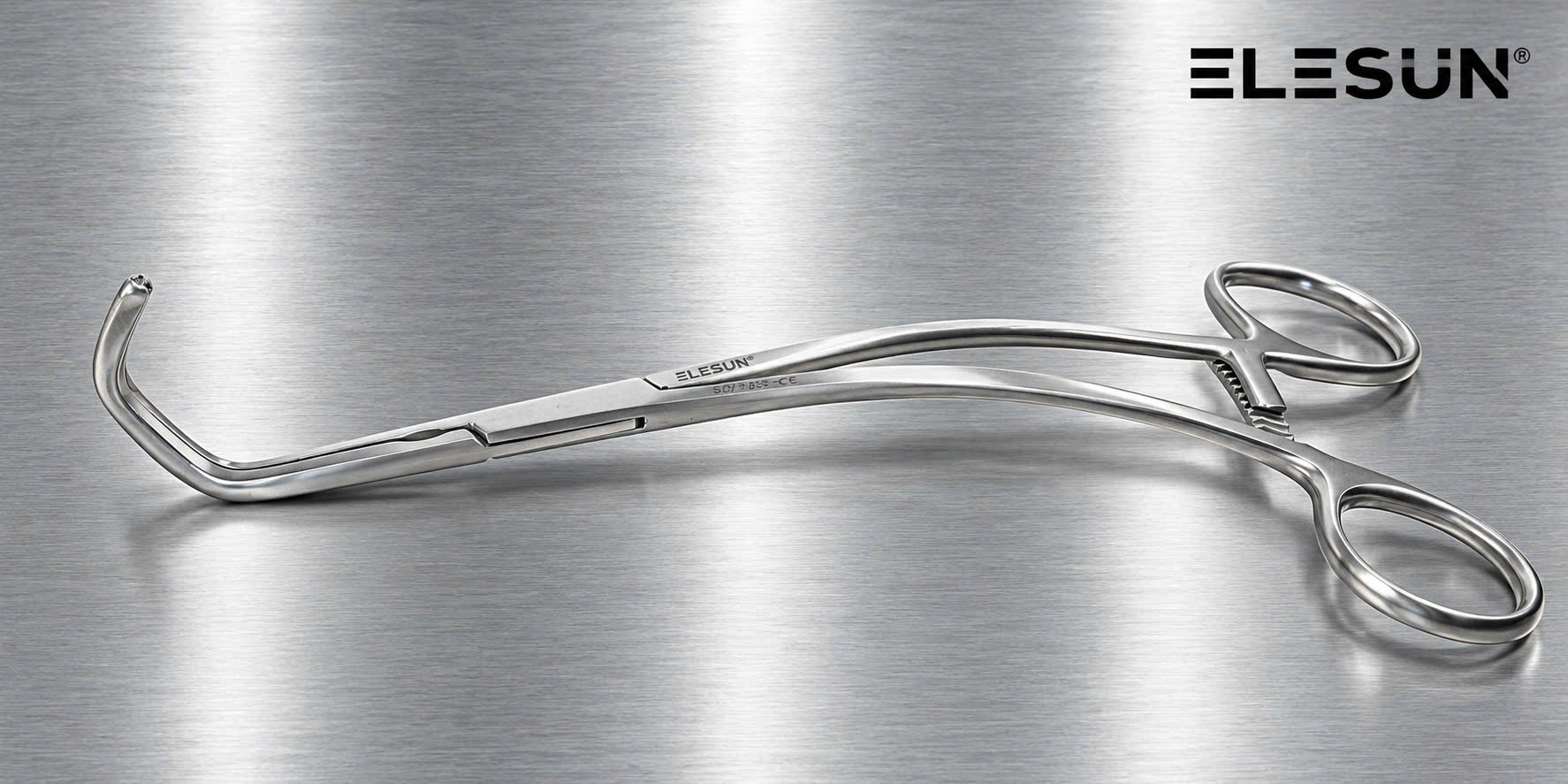
In the ELESUN catalog, the angled peripheral vascular clamp is an example of a long-shank, angled-jaw configuration with a multi-position ratchet. General principles of straight, curved and angled geometry are analyzed in the surgical instrument selection and design principles guide.
7. Jaw Geometry & Serration Patterns
The jaws are the only part of the clamp in contact with the vessel wall. When comparing vascular clamps, these geometric features determine how force is transmitted to the vessel:
- Jaw shape: straight, curved, angled or double-curved; it determines total versus partial occlusion and the direction of approach.
- Jaw length and width: the jaws must be long enough to cover the vessel diameter for total occlusion; jaw width is one of the variables of the minimum occlusive force (Sun and colleagues, 2021).
- Serration pattern: fine rows of teeth along the jaws spread force across many contact points; tooth density and depth vary between designs.
- Jaw alignment: both jaws must meet evenly along their full length on closure, without a gap at the tips or axial offset.
8. Ratchet Locks Versus Spring Mechanisms
Clamping force is held by one of two mechanisms. A ratchet lock has interlocking teeth at the end of the finger-ring handles, allowing the jaw closure to be selected and held step by step. A spring mechanism uses a cross-action leaf spring or a coil spring to close the jaws, so the clamp is self-retaining without long handles.
| Feature | Satinsky clamp | Bulldog clamp | Long-shank angled clamp |
|---|---|---|---|
| Occlusion type | Partial (tangential) | Total, on small vessels | Usually total |
| How force is held | Multi-position ratchet | Self-retaining spring, no stepwise adjustment | Multi-position ratchet |
| Handle | Finger rings | Finger plates, no long handles | Finger rings, long shanks |
| Jaw geometry | S- or C-curved | Short, straight or curved | Angled relative to the shank |
| Key inspection points | Curved-jaw alignment at every ratchet step | Spring resilience, tip closure | Jaw angle, jaw alignment, ratchet engagement |
For non-cutting articulated instruments such as ratchet clamps, ISO 7151 specifies general requirements and test methods. Spring clamps have no stepwise lock, so their clamping force depends on the design and condition of the spring.
9. Selection Criteria & Technical Precautions
When building a vascular clamp set for a department, the following criteria can guide evaluation:
- Vessel size and location: vessel diameter drives jaw length and clamp size; location drives straight, curved or angled shanks.
- Occlusion principle: whether total or partial occlusion of the vessel wall is required.
- Force mechanism: a ratchet allows stepwise closure; spring clamps are compact and self-retaining but their force is fixed by design.
- Jaw geometry and serrations: jaw alignment and serration pattern suited to the manufacturer's stated intended use.
- IFU and reprocessing: reprocessing information under ISO 17664-1, and whether serrations, joints and springs can be cleaned reliably by the central sterile services department.
Before each use and after each reprocessing cycle, check that the jaws are not bent, the serrations are intact and clean, the ratchet engages at every step, and springs remain resilient. Cleaning and sterilization principles are summarized in the surgical instrument reprocessing, cleaning and sterilization guide.
For cleaning, disinfection, and sterilization, follow the applicable manufacturer's IFU and the healthcare facility's validated reprocessing procedures.
10. Frequently Asked Questions
How does a vascular clamp differ from a general hemostatic forceps?
A general hemostatic forceps is used to grasp bleeding tissue or vessels. A vascular clamp is designed to temporarily occlude flow in a vessel that must keep functioning after the clamp is removed, so it emphasizes jaw geometry, serration patterns that spread force, and control over jaw closure. Both may share finger-ring handles and a ratchet, but they differ in intended use and jaw design.
How does a partial occlusion clamp such as a Satinsky differ from a total occlusion clamp?
A total occlusion clamp crosses the full vessel diameter and stops flow through the clamp site. A partial occlusion clamp, typically a Satinsky, uses curved jaws to take part of the wall of a large vessel, isolating a working area while the remaining lumen can continue to carry flow. Which principle to use depends on vessel size, location and the operative plan, and is decided by the surgeon.
Can the clamping force of a Bulldog clamp be adjusted?
A Bulldog clamp has no ratchet, so jaw closure cannot be selected step by step as with a finger-ring clamp. Its force is set by the spring design, jaw length and jaw shape of each model. Choosing the size and pattern of a Bulldog clamp for a given vessel diameter should therefore rely on the manufacturer's information, together with regular checks of spring resilience and tip closure.
Are "atraumatic" vascular clamps completely harmless to the vessel wall?
No. "Atraumatic" describes a jaw design intended to limit trauma; it does not guarantee that the vessel wall is unaffected. A computational model by Chen and colleagues (2010) showed that jaw shape changes the stress on the vessel wall, and a porcine aortic study by Babin-Ebell and colleagues (2010) observed endothelial damage even with moderate clamp application, with clamp duration a clear influencing factor.
What determines the minimum force needed to stop flow?
In an experimental study on rat abdominal aortas, Sun and colleagues (2021) showed that the minimum occlusive force can be calculated from three variables: vessel diameter, blood pressure and clamp jaw width, and measured values agreed with the formula. This explains why jaw size should match vessel size, but it is animal experimental data, not a parameter to apply directly in clinical practice.
What should be checked on a vascular clamp after each reprocessing cycle?
Typical checks are: the jaws meet evenly along their length without bending or axial offset; serrations are intact and free of residue; the ratchet engages at each step and releases smoothly; Bulldog springs remain resilient; and surfaces show no corrosion or cracks. Open or closed processing, lubrication and sterilization parameters must follow each instrument's IFU and the facility's validated procedures.
11. Conclusion
Vascular clamps differ mainly in occlusion principle (total or partial), force mechanism (ratchet or spring) and jaw geometry. Satinsky clamps serve tangential clamping on large vessels, Bulldog clamps provide compact temporary clamping on small vessels, and long-shank angled clamps reach deep operative fields. Appropriate selection rests on vessel size, location, jaw design and the manufacturer's IFU.
Consult ELESUN on Vascular Clamps
Explore the vascular clamp configurations in our catalog and surgical solutions supported by ELESUN technical specialists.
Related articles in the vascular instruments series
References
- Sun R., Ren L., Zhang Z., Wu X., Wang Q., Zhang S., Yang X. (2021). Pilot study of minimum occlusive force of vascular clamps on arterial vessels in rats. Scientific Reports, 11:6042 (PMC7960717).
- Chen HY., Navia JA., Shafique S., Kassab GS. (2010). Fluid–Structure Interaction in Aortic Cross-Clamping: Implications for Vessel Injury. Journal of Biomechanics, 43(2):221 (PMC2813350).
- Babin-Ebell J., Gimpel-Henning K., Sievers HH., Scharfschwerdt M. (2010). Influence of clamp duration and pressure on endothelial damage in aortic cross-clamping. Interactive CardioVascular and Thoracic Surgery, 10(2):168–171.
- ISO 7151:2024. Surgical instruments — Non-cutting, articulated instruments — General requirements and test methods. International Organization for Standardization.
- ISO 17664-1:2021. Processing of health care products — Information to be provided by the medical device manufacturer for the processing of medical devices — Part 1: Critical and semi-critical medical devices.