

Technical principles for reprocessing, cleaning, inspection, sterilization and storage of reusable surgical instruments, centered on validated processes and manufacturer IFU.
Quick Summary: Reprocessing reusable surgical instruments is a controlled sequence that may include point-of-use handling, cleaning, inspection, drying, packaging, sterilization and storage depending on the device. Cleaning and sterilization are distinct processes. Specific processing parameters must follow the manufacturer's Instructions for Use (IFU), the facility's validated process and applicable requirements.
1. The Reprocessing Lifecycle: Manufacturer IFU and Validated Processes
In contemporary surgical care, managing the lifecycle of reusable surgical instruments is vital to operating theater safety and mechanical longevity. Under international standard ISO 17664-1:2021 and regulatory frameworks established by the FDA, reprocessing is defined as a controlled technical sequence required to prepare a reusable medical device for subsequent clinical use in an appropriate manner.
This lifecycle requires close alignment across three governing pillars:
- Manufacturer Instructions for Use (IFU): Documented processing methods, chemical compatibility profiles, and technical boundaries scientifically validated by the manufacturer for the specific device model.
- Facility Validated Processes: Operational standard operating procedures and quality management workflows established within the sterile processing department (CSSD) suited to facility capabilities.
- Applicable Standards and Regulatory Requirements: Established national and international engineering and infection control standards governing medical device safety.
Instrument design and mechanical geometry — such as microscopic box locks, narrow lumens, and articulating joints found in neurosurgical and spine surgical instrument systems — directly influence sterilant penetration and cleaning accessibility. Therefore, reprocessing principles should be checked against the manufacturer’s IFU, relevant technical documentation and the validated process applicable at the facility.
2. Cleaning as the Foundation Before Disinfection and Sterilization
According to infection control guidelines published by the CDC and the World Health Organization (WHO), cleaning constitutes the indispensable first step across the entire decontamination sequence. Cleaning is defined as the physical removal of organic soil, inorganic debris, and biological bioburden from device surfaces to the extent required by the validated process.
Cleaning and sterilization represent fundamentally distinct processes. Sterilization cannot compensate for inadequate cleaning. When residual biological soil remains on device surfaces, it can form a physical shield protecting microorganisms against direct exposure to sterilizing agents, thereby compromising or negating the efficacy of subsequent sterilization cycles.
The cleaning phase begins with prompt initial treatment at the point of use to prevent soil drying, followed by manual or automated cleaning in accordance with manufacturer-validated compatibility instructions.
3. Distinguishing Disinfection from Sterilization
In clinical processing, the distinction between disinfection and sterilization is grounded in the degree of microbial inactivation and clinical intended use as classified under the Spaulding framework:
- Disinfection: A process that inactivates most recognized pathogenic microorganisms on inanimate objects, but does not guarantee the destruction of resistant bacterial spores. Disinfection is generally indicated for semicritical devices contacting mucous membranes or non-intact skin.
- Sterilization: A validated physical or chemical process intended to destroy or eliminate all viable forms of microbial life, including resistant bacterial spores.
Surgical instruments designed to enter sterile tissue cavities or the vascular system are classified as critical devices. For these instruments, sterilization through validated processes is mandatory prior to clinical use; high-level disinfection does not serve as a substitute for terminal sterilization in surgical procedures.
4. Inspection, Drying and Instrument Preparation
Following cleaning, instruments should be dried and assessed according to criteria consistent with the manufacturer’s IFU and the applicable process before moving to subsequent processing stages. Residual moisture within crevices, lumens, or surfaces can impede sterilant contact and affect sterile barrier conditions.
Assessment may include evaluating cleanliness, required dryness, surface integrity, and mechanical function when appropriate to device design and applicable instructions:
- Cleanliness and Required Dryness: Visual inspection of surfaces, hinges, or recesses under appropriate illumination to assess absence of residual soil or chemical deposits, along with meeting required dryness levels.
- Surface Integrity: Evaluating for signs of physical wear, surface pitting, stress cracks, or abnormal discoloration.
- Mechanical Function When Appropriate: Assessing mechanical action in accordance with applicable guidance for specific device designs — such as checking smooth action and spring tension in mechanical microsurgical forceps or microsurgical dissectors and nerve hooks, or assessing travel in articulated assemblies like spinal Kerrison rongeurs when relevant to manufacturer recommendations.
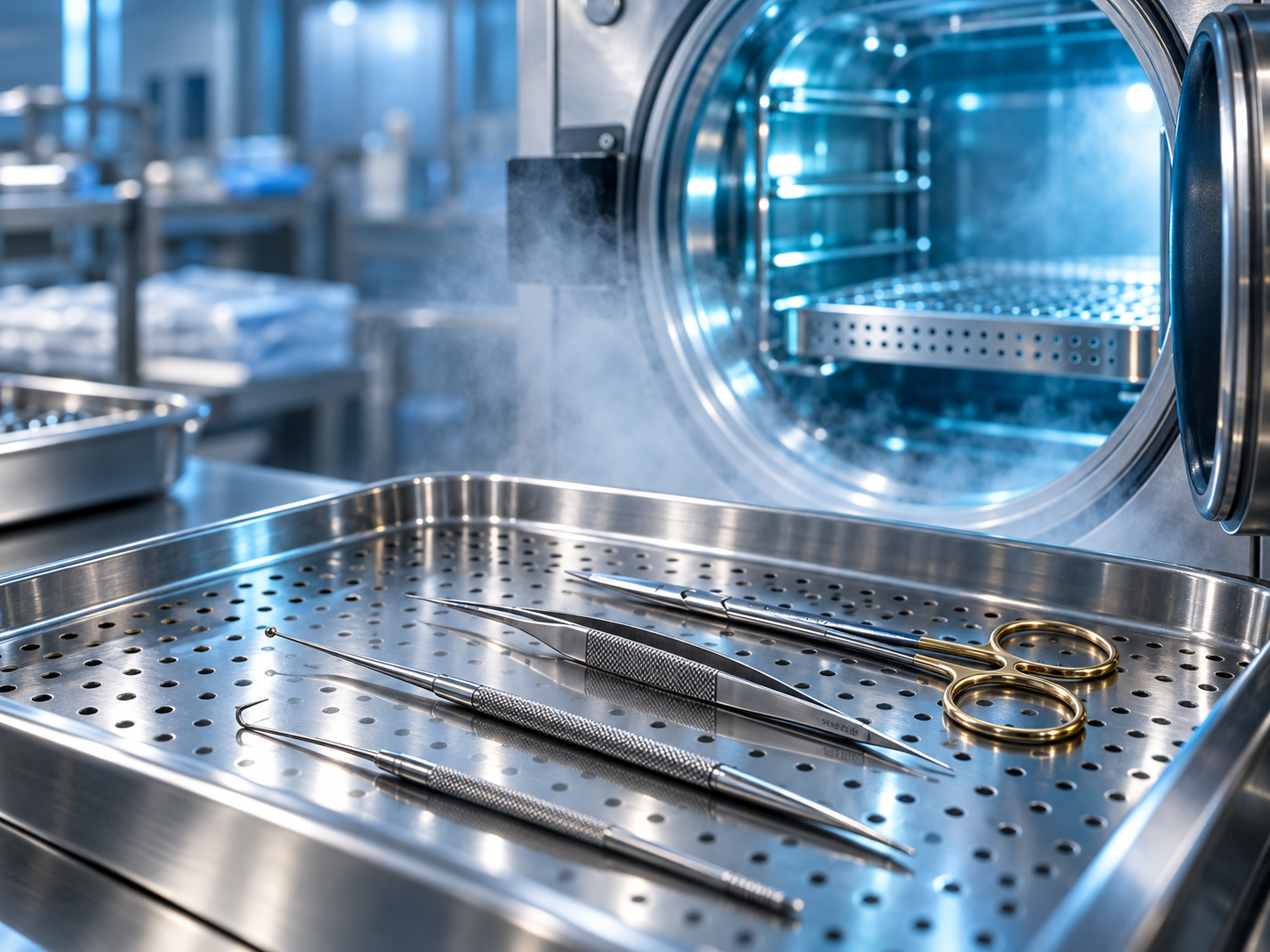
5. Packaging and Storage After Processing
Packaging devices prior to entering the sterilization chamber establishes a sterile barrier system. Sterile packaging or dedicated rigid containers fulfill complementary technical roles: facilitating effective sterilant penetration during the cycle while safeguarding instruments against environmental microbial recontamination following cycle completion.
Following sterilization, environmental storage parameters preserve barrier integrity:
- Instruments must be stored in environmentally controlled clean areas with managed temperature, humidity, and airflow.
- Adequate spacing should avoid stacking loads that could puncture wrapping materials or distort delicate instrument tips.
- Sterility maintenance adheres to event-related sterility principles rather than arbitrary time limits alone. If packaging or the sterile barrier system is compromised, subsequent assessment and handling should follow the facility’s applicable procedure and relevant instructions.
6. Quality Control and Traceability in Reprocessing
Quality assurance across sterile processing depends upon rigorous documentation and process monitoring. Validating sterilization cycles through physical cycle monitoring, chemical indicators, and biological indicators confirms that critical processing parameters satisfied predetermined acceptance criteria.
Traceability systems linking tray identifiers, sterilizer load records, processing dates, and clinical procedures enable healthcare facilities to manage infection control governance transparently. Continuous staff technical training and personal protective equipment (PPE) protocols provide the operational foundation to support consistent operation of the process and safe working practices for personnel involved in instrument reprocessing.
Frequently Asked Questions
How are cleaning and sterilization different for surgical instruments?
Cleaning is the removal of organic and inorganic soil from device surfaces, whereas sterilization is a validated physical or chemical process intended to destroy or eliminate viable microorganisms. Inadequate cleaning can interfere with the effectiveness of subsequent disinfection or sterilization processes.
Why must the IFU for each instrument be followed?
Each surgical instrument features distinct mechanical designs, materials, and geometric complexities. Manufacturer Instructions for Use (IFU) provide tested, validated processing methods specific to that device model, which must be implemented alongside facility-approved procedures.
Can one sterilization cycle be used for every reusable instrument?
No. Specific processing parameters depend upon device construction, material characteristics, and the manufacturer's validated instructions. A universal reprocessing cycle or method should not be assumed across all surgical instruments.
What should be assessed before an instrument is packaged and stored?
Before packaging and storage, instruments should be assessed for cleanliness, required dryness, integrity and mechanical function in accordance with the manufacturer’s IFU and the applicable process.
References
- ISO 17664-1:2021. Processing of health care products — Information to be provided by the medical device manufacturer for the processing of medical devices — Part 1: Critical and semi-critical medical devices.
- CDC / Rutala WA., Weber DJ. Guideline for Disinfection and Sterilization in Healthcare Facilities. Centers for Disease Control and Prevention (Updated 2024).
- FDA. Reprocessing Medical Devices in Health Care Settings: Validation Methods and Labeling. U.S. Food and Drug Administration (2015, Appendix E updated 2017).
- WHO. Decontamination and Reprocessing of Medical Devices for Health-care Facilities. World Health Organization (2016).