
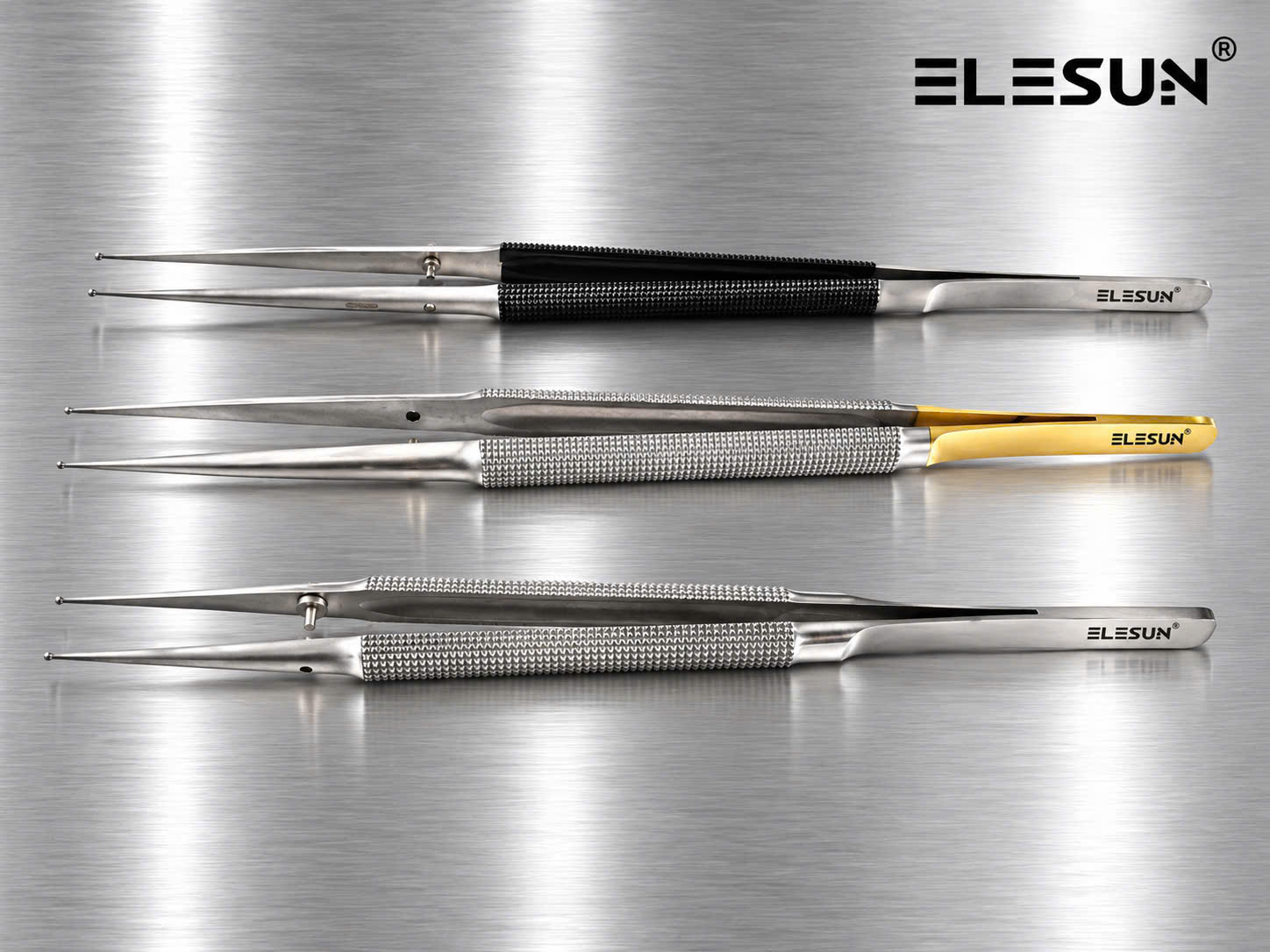
A technical guide to mechanical microsurgical forceps covering straight and bayonet shaft geometry, working ends, spring handles, and instrument selection considerations.
1. Microsurgical Forceps: Definition & Terminology Boundaries
In microsurgical operative fields, procedural accuracy during tissue grasping and suture manipulation depends directly on instrument geometry and mechanical responsiveness. Microsurgical forceps represent a distinct family of passive mechanical instruments featuring dual-leaf spring handles, precision-engineered to grasp delicate soft tissues, assist micro-dissection, and manipulate micro-sutures beneath surgical operating microscopes.
From a technical taxonomy standpoint, mechanical micro forceps operate purely through manual mechanical forces transmitted from the surgeon's fingertips, incorporating no electrical circuitry or thermal coagulation mechanisms. They differ fundamentally from conventional surgical tissue forceps in their ultra-slender working ends, microscopic tip alignment tolerances, and specialized compatibility with narrow optical corridors.
Within the neurosurgical and spine surgical instruments ecosystem and the ELESUN microsurgery instrument catalog, micro forceps constitute an indispensable foundation alongside micro-scissors and dissectors for all microsurgical workflows requiring optical magnification.
2. Shaft Geometry: Straight & Bayonet Configurations
Shaft geometry dictates mechanical force transmission axes and optical corridor clearance. In mechanical microsurgical forceps design, the two primary shaft architectures are straight-shaft and bayonet-shaft (offset) configurations:
- Straight-shaft configuration: The axis from the handle shanks to the working tips remains completely linear. This architecture provides direct axial force feedback, making it ideal for superficial operative fields, direct operative approaches, or peripheral microsurgical interventions where deep anatomical corridors do not obstruct the visual field.
- Bayonet-shaft configuration: The instrument shaft incorporates an offset step geometry. As described by Matsumura (2012), bayonet architecture displaces the handle shanks and the surgeon's fingers away from the coaxial visual axis of the operating microscope. Consequently, the operating surgeon maintains an unobstructed line of sight directly into narrow, deep corridors without visual interference from manipulating hands.
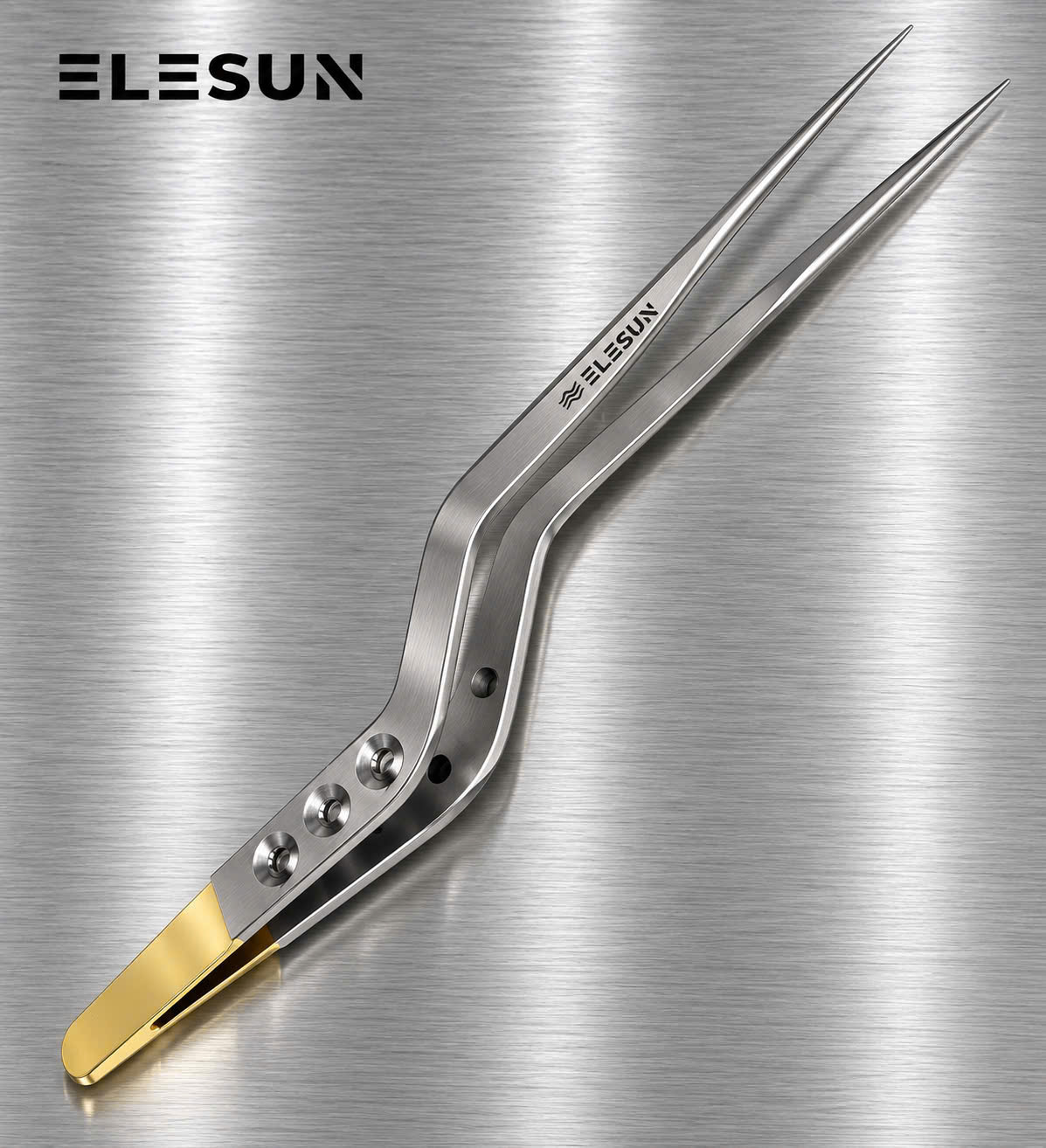
Selecting between straight and bayonet shaft configurations is guided primarily by surgical working depth and illumination angles, preventing shadow projection over critical anatomical targets.
3. Working Ends & Model-Specific Variations
The working tips are the functional interface with biological tissues and suture materials. Working-end configurations are precision-machined according to distinct functional requirements:
- Straight fine tips: Provide pinpoint spatial access into narrow tissue planes while minimizing visual displacement within microscopic fields.
- Smooth tips: Feature polished inner grasping faces suited for delicate soft tissue handling without causing mechanical surface pinching.
- Serrated tips: Incorporate micro-machined serrations to enhance frictional traction when grasping moist or lubricated tissue structures.
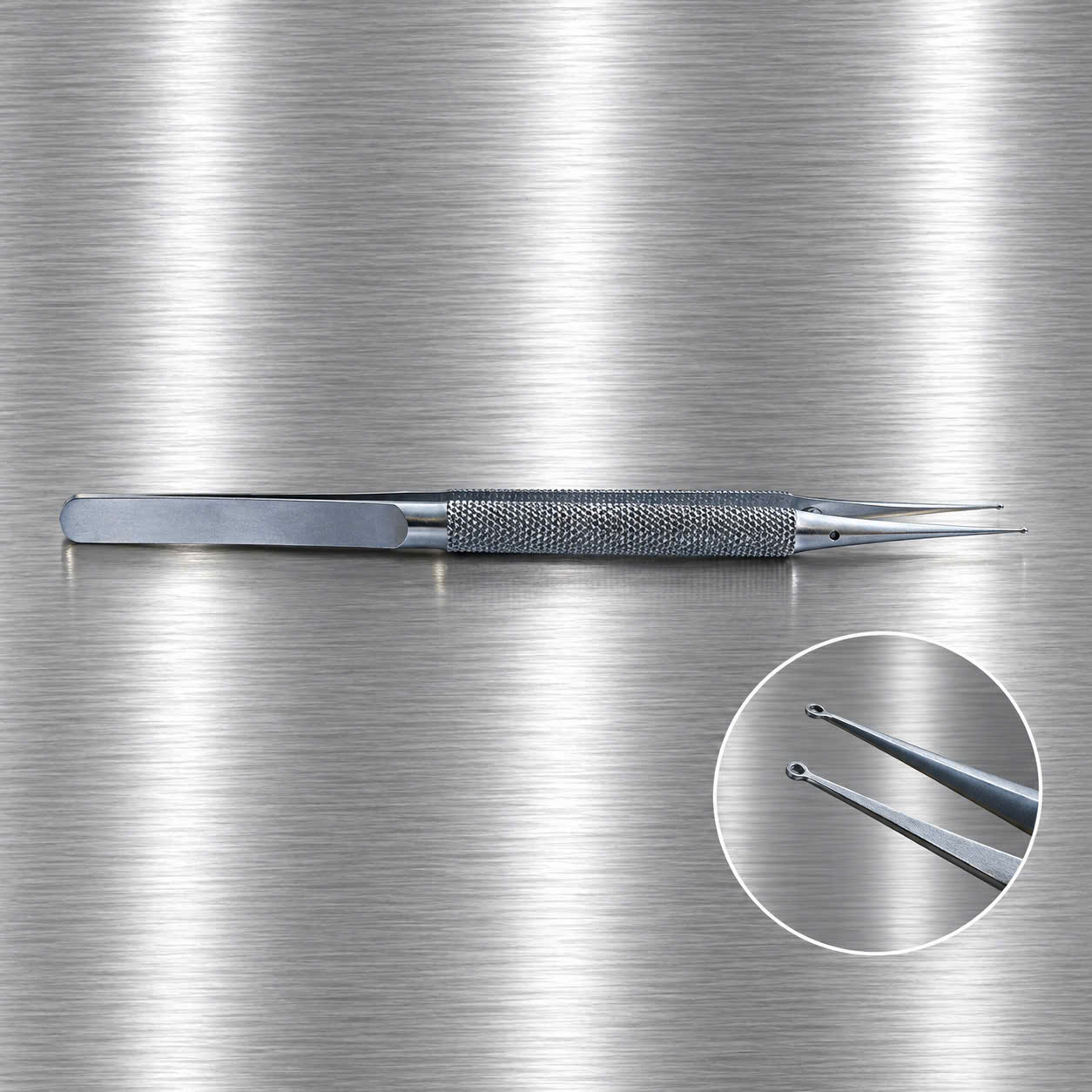
Within the ELESUN catalog, verified models such as the micro forceps with dimpled handle and the round knurled handle micro forceps demonstrate slender straight working ends adhering to stringent alignment standards.
4. Spring-Handle Architecture & Handling Characteristics
In contrast to ring-handled surgical clamps, microsurgical forceps rely on a dual-leaf spring handle mechanism. This architecture joins two resilient shanks at the proximal end, providing passive spring elasticity that automatically returns the working tips to an open position upon relaxation of finger pressure.
The dual-leaf spring design facilitates a modified pencil grasp (writing grasp) as analyzed by Matsumura (2012). This grip utilizes coordinated fingertip control across the thumb, index, and middle fingers, transforming gross wrist articulation into stabilized micro-movements and helping dampen physiological tremor under magnification.

Handle surfaces feature tactile friction patterns: wide handle plates with recessed circular dimples (dimpled handles) or round cylindrical shanks with diamond knurling (knurled handles). These machined textures provide reliable anti-slip stability in moist operative environments without requiring excessive pinching force.
5. Technical Considerations When Evaluating Microsurgical Forceps
As outlined in neurosurgical instrumentation principles reviewed by Hernesniemi and colleagues (2005), instrument selection requires careful alignment between operative corridor depth, tissue handling requirements, and ergonomic balance. Biomedical procurement committees and surgical teams evaluate the following mechanical dimensions:
| Evaluation Dimension | Straight Shaft Configuration | Bayonet Shaft Configuration |
|---|---|---|
| Visual Corridor | Direct axial force; optimal for superficial, direct-line visualization | Offset handle axis; clears the coaxial microscope light path |
| Working Depth | Suited for peripheral and shallow surgical exposures | Suited for deep, narrow corridors (cranial base, deep spine) |
| Tip Alignment | Tips meet in planar opposition under minimal closure force | Requires high structural rigidity to resist torque at the bayonet bend |
| Surface Finish | Satin anti-glare finish dampening surgical light reflections | Satin anti-glare finish reducing glare under coaxial microscope light |
| Balance & Ergonomics | Linear center-of-gravity distribution | Counterbalanced handle weighting minimizing rotational torque |
Appropriate matching of working length and shaft geometry minimizes muscle fatigue during prolonged microsurgical procedures, preserving manual stability.
6. Mechanical Forceps, Bipolar Forceps & Related Instrument Categories
In surgical equipment specifications, instrument categories with similar nomenclature must be clearly distinguished:
- Passive mechanical forceps: Manual grasping and dissection tools operating purely through fingertip spring compression without electrical energization.
- Bipolar coagulating forceps: Part of active electrosurgical systems (Huang & Wang, 2017). They conduct high-frequency current across insulated limbs to generate thermal electrocoagulation at the tips, representing an entirely different functional category.
- Bulldog and vascular clamps: Belong to the temporary occlusion clamp family, featuring self-closing spring mechanisms for hemostatic vascular control. They do not constitute a subtype of microsurgical tissue forceps.
- Aneurysm clips: Implantable or temporary vascular closure devices applied via specialized clip-appliers.
- Micro needle holders: Feature heavy-duty grasping jaws designed to stabilize surgical needles, distinct from atraumatic tissue-grasping forceps.
For cleaning, disinfection, and sterilization, follow the applicable manufacturer's IFU and the healthcare facility's validated reprocessing procedures.
References
- Matsumura N. (2012). A new bayonet spring microsurgical instrument handle with a bar for microneurosurgery. Surgical Neurology International, 3:152 (PMC3551495).
- Hernesniemi J. et al. (2005). Some collected principles of microneurosurgery: simple and fast, while preserving normal anatomy: a review. Surgical Neurology, 64(3):195-200 (PMID: 16099243).
- Huang HK., Wang JP. (2017). A Method to Facilitate "Nonsticking" of Regular Bipolar Forceps. Journal of Hand and Microsurgery, 9(2):113-114 (PMC5578816).