
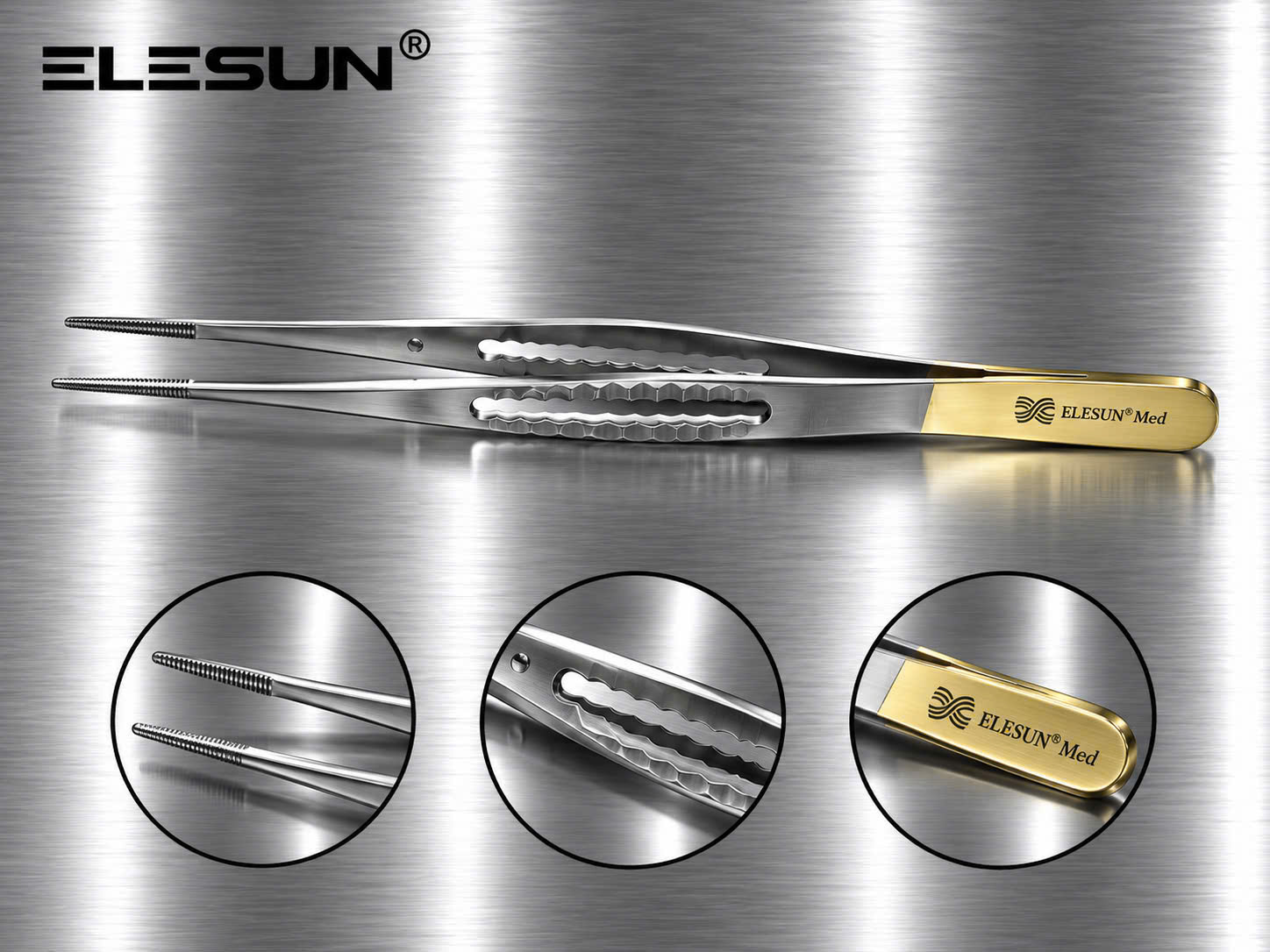
Vascular surgical instruments are mechanical instruments used to dissect, temporarily control, cut and suture blood vessels — including vascular clamps, dissecting forceps, scissors, needle holders and microvascular instruments. This guide classifies the main groups, explains their mechanical functions and outlines technical selection criteria.
1. What Are Vascular Surgical Instruments?
Vascular surgical instruments are mechanical surgical instruments designed to work on the vessel wall: exposing and dissecting vessels free from surrounding tissue, temporarily controlling blood flow, opening and cutting the vessel wall, and holding the needle during suturing and anastomosis. The five main groups are vascular clamps, vascular dissecting forceps, vascular scissors, vascular needle holders and microvascular instruments used under magnification.
What these groups share is the need for precise mechanical control on a soft, pressurized and easily injured structure. Jaw geometry, the serration pattern of the contact surface, the locking or spring mechanism and the working length therefore matter more here than for many general surgical instruments.
This article is general professional knowledge. For currently available configurations, see the ELESUN vascular surgery instrument catalog. It does not replace the manufacturer's instructions for use (IFU), facility procedures or the surgeon's professional judgment.
2. What Is Surgical Vascular Dissection?
Surgical vascular dissection is the operative technique of exposing a vessel segment and separating it from connective tissue and adjacent structures, creating room to apply proximal and distal control before the vessel is opened, anastomosed or repaired. Vascular dissection instruments used at this stage typically include fine-tipped dissecting forceps, dissecting scissors and blunt dissectors.
Terminology note: Surgical vascular dissection is a deliberate operative step. It is entirely different from arterial dissection (for example, aortic dissection) — a disease in which a tear in the intimal layer allows blood to enter the vessel wall and create a false lumen (StatPearls, NBK441963). This article covers only instruments for surgical dissection.
3. Main Instrument Groups & Their Mechanical Functions
Each vascular instrument group performs a distinct mechanical function in the workflow. The table below summarizes the function and typical mechanism of each group:
| Instrument group | Primary mechanical function | Typical mechanism |
|---|---|---|
| Vascular clamps | Temporary total or partial occlusion of flow | Finger-ring handles with multi-position ratchet; or self-retaining spring (Bulldog) |
| Vascular dissecting forceps | Holding the vessel wall and perivascular tissue during dissection and suturing | Two spring limbs with finely serrated working tips |
| Vascular scissors | Cutting tissue, extending the arteriotomy, cutting sutures | Pivot joint with straight, curved or angled blades |
| Vascular needle holders | Stabilizing the needle during anastomosis | Short load-bearing jaws, ratchet lock, long shanks for deep fields |
| Microvascular instruments | Handling small vessels under magnification | Spring handles, ultra-fine tips, small microvascular clamps |
4. Vascular Clamps: Satinsky, Bulldog & Angled Configurations
Vascular clamps provide temporary control of flow within the vessel lumen. Jaw configuration determines whether a clamp occludes the full circumference of the vessel or only part of the wall, while the locking or spring mechanism determines how clamping force is maintained.
Satinsky clamps (tangential clamps)
Satinsky clamps are side-biting (tangential) clamps with curved jaws used to clamp part of the wall of a large vessel. With tangential clamping, the remaining lumen can continue to carry flow while a working area is isolated on the vessel wall. They have finger-ring handles and a multi-position ratchet. See the Satinsky tangential vascular clamp in the ELESUN catalog.
Bulldog vascular clamps
Bulldog vascular clamps are small self-retaining clamps without long handles; their jaws close under spring force. Their compact size lets them remain on peripheral vessels or small branches without occupying the operative field. Because clamping force is set by the spring, choosing the right size and pattern for a given vessel diameter should rely on the manufacturer's information. See the Bulldog vascular clamp.
Angled-jaw, long-shank clamps
In deep operative fields, or where a vessel lies behind other anatomical structures, angled-jaw clamps with long shanks bring the jaws onto the vessel axis while the handles remain outside the line of sight. Jaw angle, jaw length and shank length should be matched to the intended anatomical location.
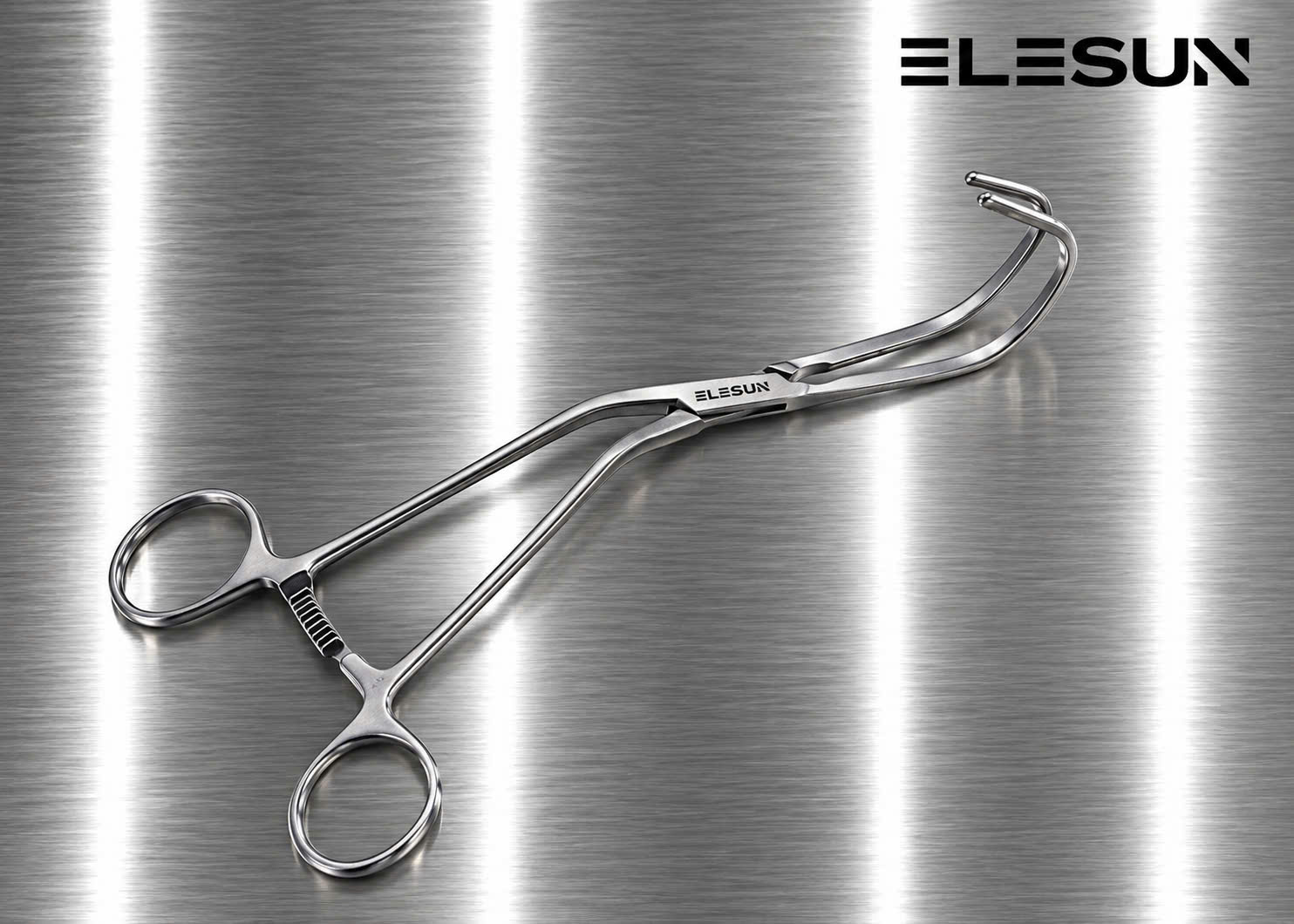
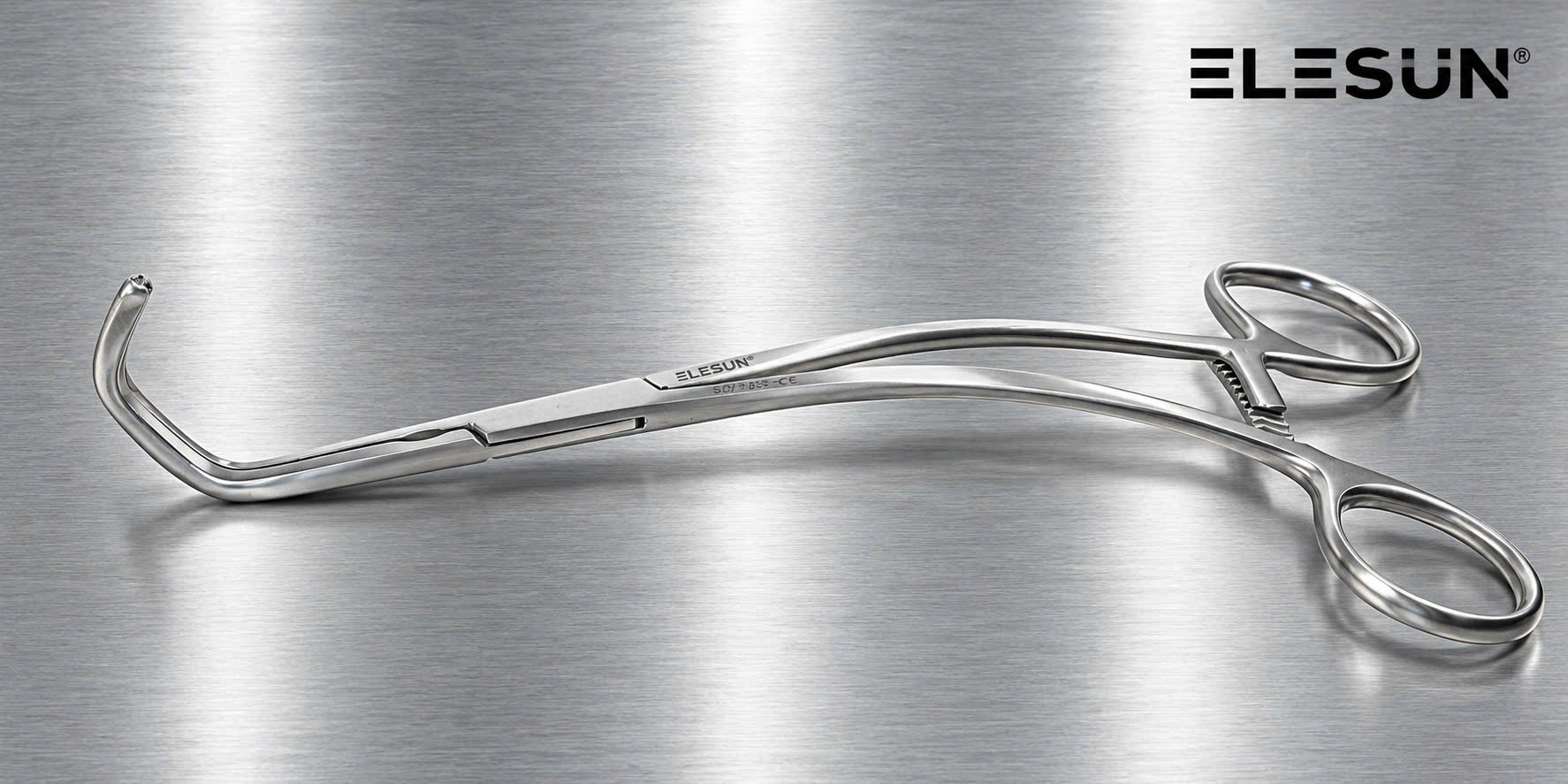
In the ELESUN catalog, the angled peripheral vascular clamp is an example of a long-shank, angled-jaw configuration with a multi-position ratchet.
The term "atraumatic" is commonly used to describe vascular clamp serration patterns, but it describes a design intent rather than a guarantee that the vessel wall is unaffected. A computational fluid–structure model of aortic cross-clamping by Chen and colleagues (2010) found that the shape of the jaw contact surface substantially changed the stress distributed to the vessel wall, particularly on the luminal side. Jaw pattern and ratchet position should therefore be chosen according to the IFU and professional judgment for each situation.
5. Vascular Dissecting Forceps & Working-Tip Geometry
Vascular dissecting forceps (also called vascular tissue forceps) are hand-held instruments with two limbs joined at the proximal end, operating through the spring elasticity of the shanks. They are used to hold the vessel wall, adventitia and perivascular tissue during dissection or anastomosis.
The DeBakey pattern is a widely used configuration in cardiovascular and vascular surgery. According to a review by Salehi (2024), its defining features are small serrations along the jaws, designed to spread grasping pressure across many contact points to limit tissue injury, together with long shanks and fine tips for reaching deep operative fields. These are the forceps often described as atraumatic vascular forceps.
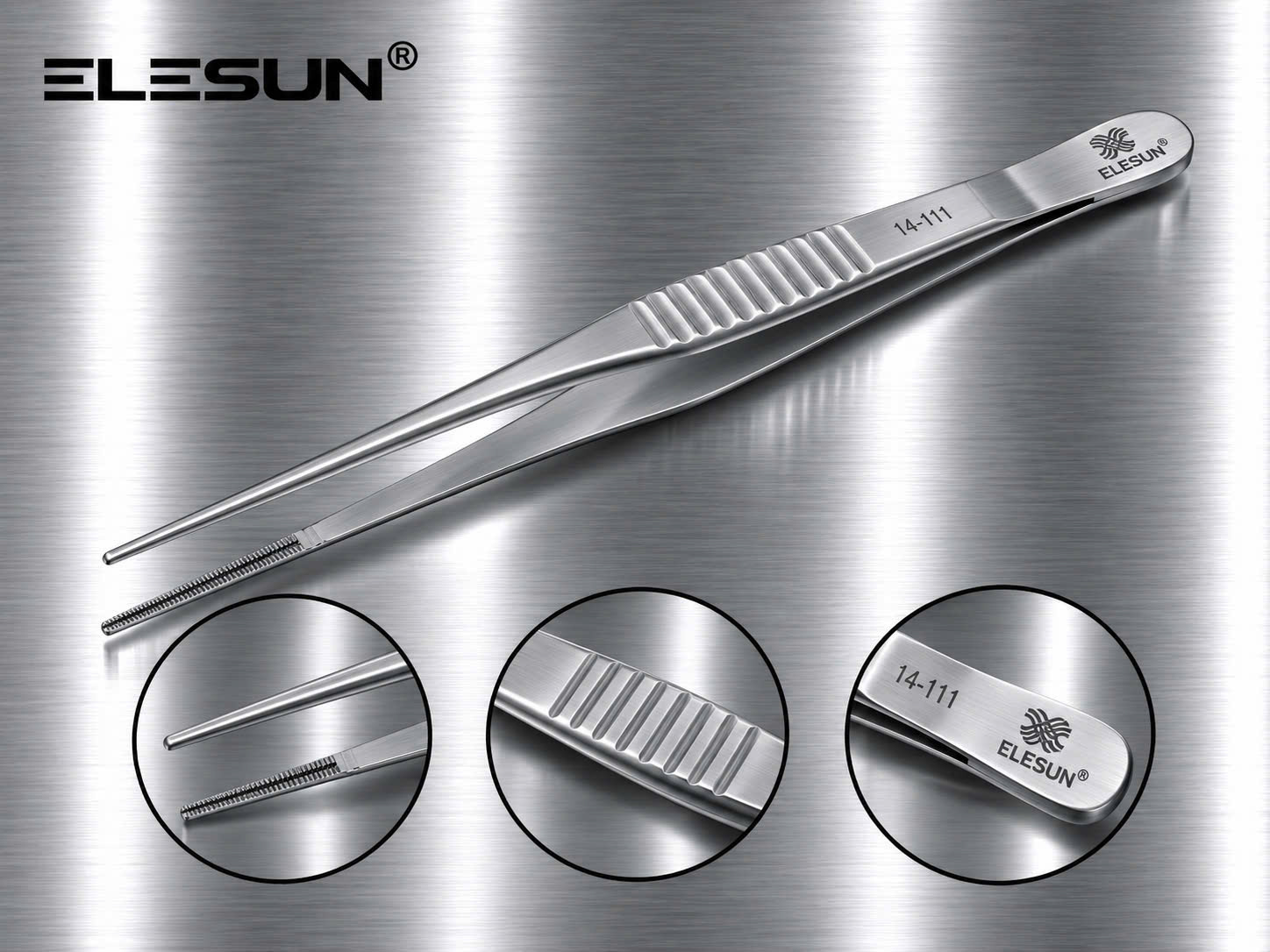
When assessing working-tip geometry, consider the width and length of the serrated area, the serration pattern (longitudinal, transverse or fine rows of teeth), how well the tips meet on closure, straight versus curved tips, and overall length relative to field depth. A ribbed or textured grip area improves purchase during handling. General principles of straight, curved, angled and bayonet geometry are analyzed in the surgical instrument selection and design principles guide.
The DeBakey-pattern configuration currently in the catalog is the DeBakey vascular tissue forceps with fenestrated shanks.
6. Vascular Scissors
Vascular scissors are used to cut perivascular tissue during dissection, to extend an arteriotomy and to cut sutures. The orientation of the blades relative to the shank largely determines how well the scissors can cut along the vessel wall in a confined space.
- Potts-Smith-pattern scissors: fine blades angled relative to long shanks, used to extend the arteriotomy along the vessel axis. See the Potts-Smith angled vascular scissors in the ELESUN catalog.
- Straight or curved dissecting scissors: used to separate and cut connective tissue around the vessel during exposure.
- Spring-handled micro scissors: used on small vessels under magnification, covered in the microvascular section below.
When evaluating vascular scissors, check cutting sharpness and blade contact along the full cutting length, smoothness of the pivot joint and alignment of the two tips.
7. Needle Holders & Microvascular Instruments
Vascular needle holders
Vascular needle holders hold fine suture needles securely during anastomosis. Short jaws with a gripping surface suited to the needle size, combined with a ratchet lock, help keep the needle from rotating as it passes through the vessel wall; long shanks support suturing in deep fields. Jaw size should be compatible with the intended needle size. See the long-shank vascular needle holder.
Fine-tipped forceps & microvascular instruments
Small vessels are usually handled under loupes or an operating microscope. Microvascular instruments include spring-handled micro forceps, micro scissors, micro needle holders and small microvascular clamps. They share very fine working tips and round or flat handles held in a pencil grip, which translates finger movement into small, stable motions. The shaft and tip architecture of micro forceps is analyzed in detail in the microsurgical forceps guide.
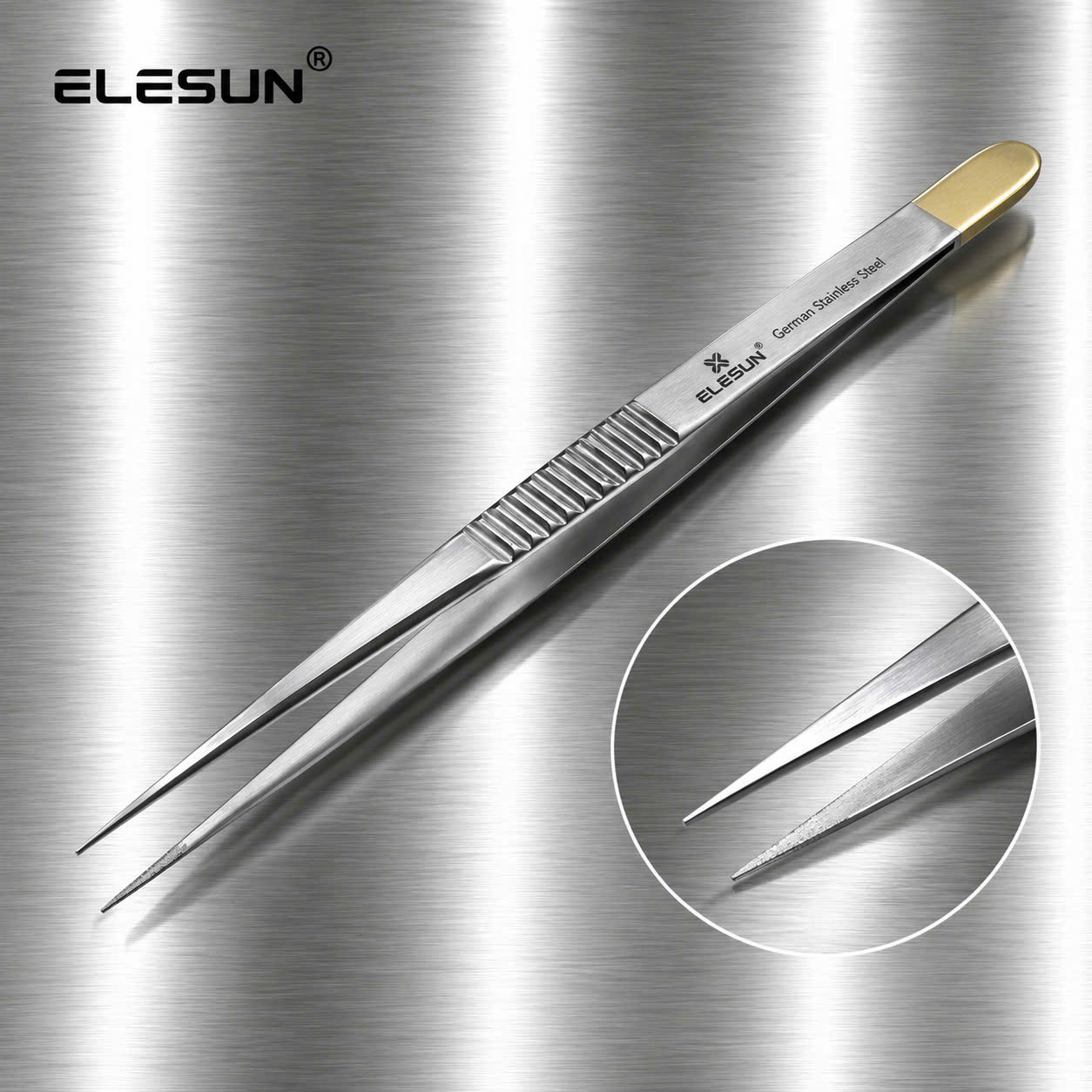
Whether a fine-tipped forceps is suitable for microvascular work depends on its specific configuration and the manufacturer's stated intended use. Current microsurgical configurations are presented in the ELESUN microsurgery instrument catalog.
8. How to Select Vascular Surgical Instruments
No single vascular set suits every case. Selection should be decided by the surgeon and the clinical committee, based on the following groups of technical criteria:
| Criterion | Technical question to answer |
|---|---|
| Anatomy & vessel size | Expected vessel diameter and wall thickness? Total or partial occlusion required? |
| Access | Field depth and approach direction; straight, curved or angled shanks? |
| Jaw design | Jaw length, curvature and angle; serration pattern of the contact surface |
| Gripping characteristics | Tip width, jaw alignment, secure hold without added closing force |
| Mechanical control | Number of ratchet positions, spring force, smoothness of the joint |
| Intended use & IFU | Manufacturer-stated intended use and accompanying reprocessing instructions |
For non-cutting articulated instruments such as vascular clamps and needle holders, ISO 7151 specifies general requirements and test methods. For instrument body materials, see the surgical instrument materials and technical standards guide, which covers standards such as ASTM F899 and ISO 7153-1.
9. Technical Inspection, Cleaning, Sterilization & IFU
Fine serrations, pivot joints and ratchets are where biological residue tends to remain, and also where mechanical wear directly affects the function of vascular instruments. Common technical inspection points after each reprocessing cycle include:
- Jaws and tips meet correctly on closure, without misalignment or bending.
- Serrations are intact, free of residue, and show no chipping or unusual wear.
- The ratchet engages at each position and releases smoothly; springs on Bulldog clamps and forceps remain resilient.
- Scissor blades cut evenly along the full blade length and the tips close in alignment.
- Surfaces show no corrosion, pitting or cracks.
Under ISO 17664-1, the manufacturer is responsible for providing the information needed to process critical and semi-critical medical devices. Whether an instrument is processed open or closed, disassembly, lubrication and sterilization parameters must follow the IFU for each instrument together with the facility's validated procedures. The CDC disinfection and sterilization guideline likewise emphasizes that thorough cleaning must precede disinfection or sterilization. General principles are summarized in the surgical instrument reprocessing, cleaning and sterilization guide.
For cleaning, disinfection, and sterilization, follow the applicable manufacturer's IFU and the healthcare facility's validated reprocessing procedures.
10. Selection & Procurement Checklist for Hospitals
When building or expanding a vascular instrument set, clinical departments and procurement teams can use the following checklist:
- Identify the procedures to be equipped and the instrument groups needed for each stage: dissection, vascular control, vessel opening and anastomosis.
- List the required configurations for each group: length, straight, curved or angled shanks, jaw type and serration pattern.
- Ask suppliers for the IFU, reprocessing information and material declaration for each instrument code.
- Check the reprocessing requirements in the IFU against the capabilities of the central sterile services department.
- Request evaluation samples so surgeons can assess handling, jaw alignment and lock function.
- Verify the product's regulatory documentation under the medical device regulations that apply.
- Plan periodic inspection, maintenance and replacement throughout the instruments' service life.
11. Frequently Asked Questions
What are the main types of vascular surgical instruments?
Vascular surgical instruments can be grouped into five types by mechanical function: vascular clamps for temporary flow control; vascular dissecting forceps for holding the vessel wall and perivascular tissue; vascular scissors for cutting tissue and extending the arteriotomy; vascular needle holders for holding the needle during anastomosis; and microvascular instruments used under magnification. Each group comes in many configurations of length, angle and jaw pattern, selected according to the procedure and each instrument's IFU.
Is surgical vascular dissection the same as arterial dissection?
No. Surgical vascular dissection is a deliberate operative step that exposes a vessel segment and separates it from surrounding tissue so it can be controlled and treated. Arterial dissection, such as aortic dissection, is a disease: a tear in the intimal layer allows blood to enter the vessel wall and create a false lumen (StatPearls, NBK441963). The two terms sound similar but describe entirely different things.
How do vascular clamps work?
A vascular clamp closes its jaws on the vessel wall to temporarily occlude all or part of the flow. Clamping force is held either by a multi-position ratchet on finger-ring clamps or by spring force on self-retaining clamps such as Bulldogs. A computational model by Chen and colleagues (2010) showed that the shape of the jaw contact surface affects how stress is distributed to the vessel wall, so jaw pattern and ratchet position should be chosen according to the IFU and professional judgment.
What is the difference between Bulldog and Satinsky clamps?
A Bulldog clamp is a small self-retaining clamp that closes under spring force and has no long handles. It is typically used for temporary occlusion of peripheral vessels or small branches and can remain on the vessel without occupying the operative field. A Satinsky clamp is a tangential (side-biting) clamp with finger-ring handles, curved jaws and a multi-position ratchet, used to clamp part of the wall of a large vessel while the remaining lumen can continue to carry flow.
What are the features of DeBakey forceps?
DeBakey-pattern forceps are hand-held spring forceps with long shanks and fine working tips for reaching deep operative fields. According to a review by Salehi (2024), their defining feature is a set of small serrations along the jaws, designed to spread grasping pressure across many contact points to limit tissue injury. The term "atraumatic" describes this design intent; it does not guarantee that tissue is entirely unaffected.
How should vascular surgical instruments be selected?
The main criteria are vessel anatomy and size; field depth and approach direction, which determine straight, curved or angled shanks; jaw design and serration pattern; gripping characteristics such as tip width and jaw alignment; mechanical control such as the number of ratchet positions and spring force; and the intended use and IFU published by the manufacturer. The final decision rests with the surgeon and the facility's clinical committee.
How should vascular surgical instruments be reprocessed?
Cleaning, disinfection, inspection and sterilization must follow each instrument's IFU and the facility's validated procedures. Under ISO 17664-1, the manufacturer is responsible for providing the information needed for reprocessing, and the CDC guideline emphasizes that thorough cleaning must precede disinfection or sterilization. Serrations, pivot joints and ratchets need particular attention during cleaning and inspection. Whether an instrument is processed open or closed, and whether lubrication is used, must also follow the IFU.
12. Conclusion
Vascular surgical instruments form a system of complementary groups: dissecting forceps and scissors for exposure, vascular clamps for flow control, and needle holders and microvascular instruments for anastomosis. Appropriate selection rests on anatomy, access, jaw design and mechanical control, with the manufacturer's IFU followed throughout the instruments' service life.
Consult ELESUN on Vascular Instruments
Explore our vascular instrument catalog and surgical solutions supported by ELESUN technical specialists.
References
- Salehi S. (2024). The Impact of DeBakey Forceps on Cardiac Surgery: Revolutionizing the Surgical Landscape. Cureus, 16(6):e63121 (PMC11271757).
- Chen HY., Navia JA., Shafique S., Kassab GS. (2010). Fluid–Structure Interaction in Aortic Cross-Clamping: Implications for Vessel Injury. Journal of Biomechanics, 43(2):221 (PMC2813350).
- NCBI Bookshelf / StatPearls — Aortic Dissection (NBK441963).
- ISO 7151:2024. Surgical instruments — Non-cutting, articulated instruments — General requirements and test methods. International Organization for Standardization.
- ISO 17664-1:2021. Processing of health care products — Information to be provided by the medical device manufacturer for the processing of medical devices — Part 1: Critical and semi-critical medical devices.
- CDC / Rutala WA., Weber DJ. Guideline for Disinfection and Sterilization in Healthcare Facilities. Centers for Disease Control and Prevention (Updated 2024).