
A technical guide to microsurgical dissectors and nerve hooks covering working-end geometry, shaft configurations, and instrument evaluation principles.
1. Definition & Terminology Boundaries
Within the neurosurgical and spine instrument system and the ELESUN Neuro-Spine portfolio, dissection and exploration tools fulfill foundational roles under operative magnification. To ensure precision during technical evaluations and instrument selection, clear terminology boundaries must distinguish adjacent instrument classes:
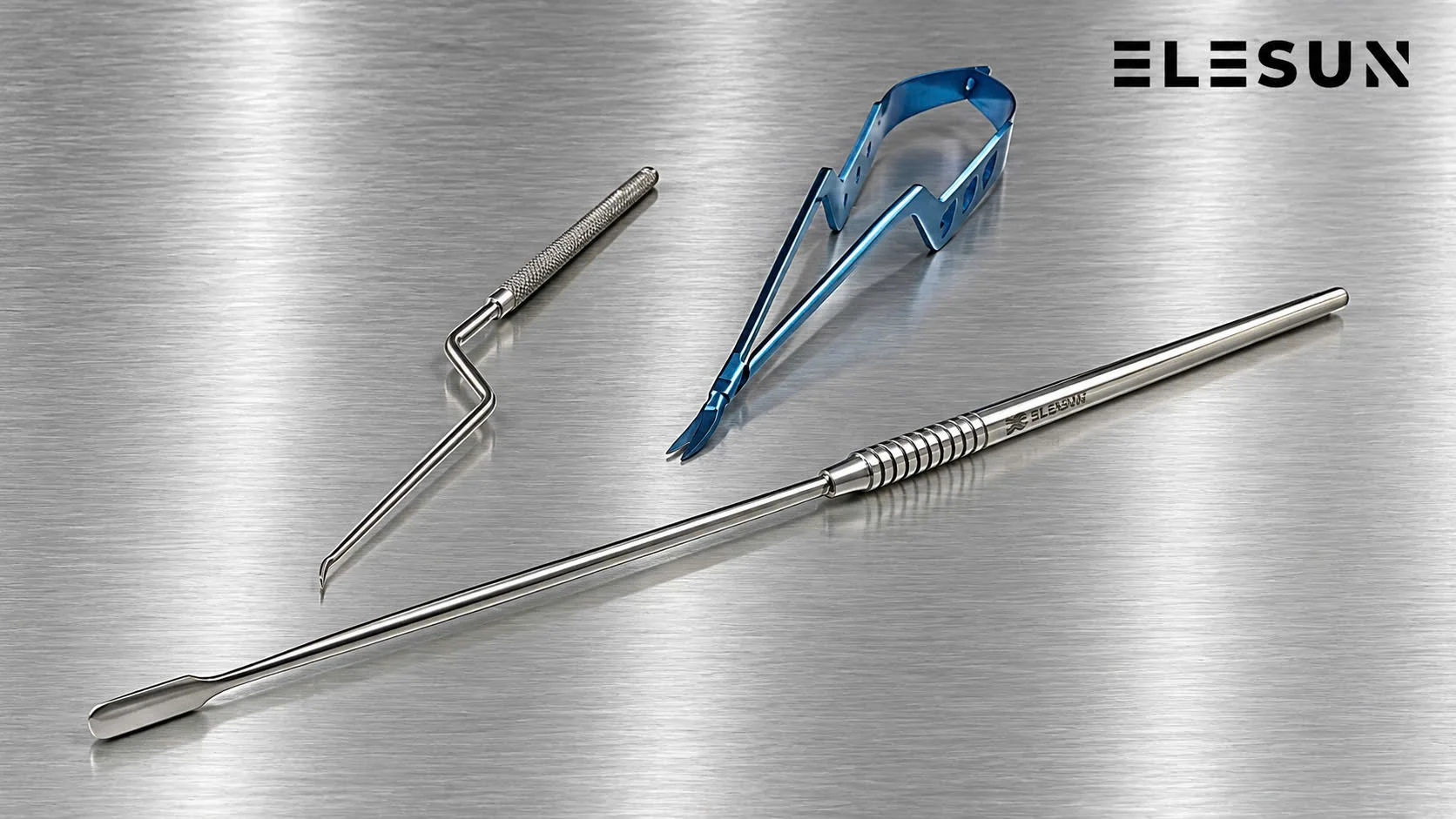
- Microsurgical Dissector: A manual microsurgical instrument that may use flat or spatula-shaped working ends; this article focuses on working-end geometry and shaft configuration for tissue-plane separation.
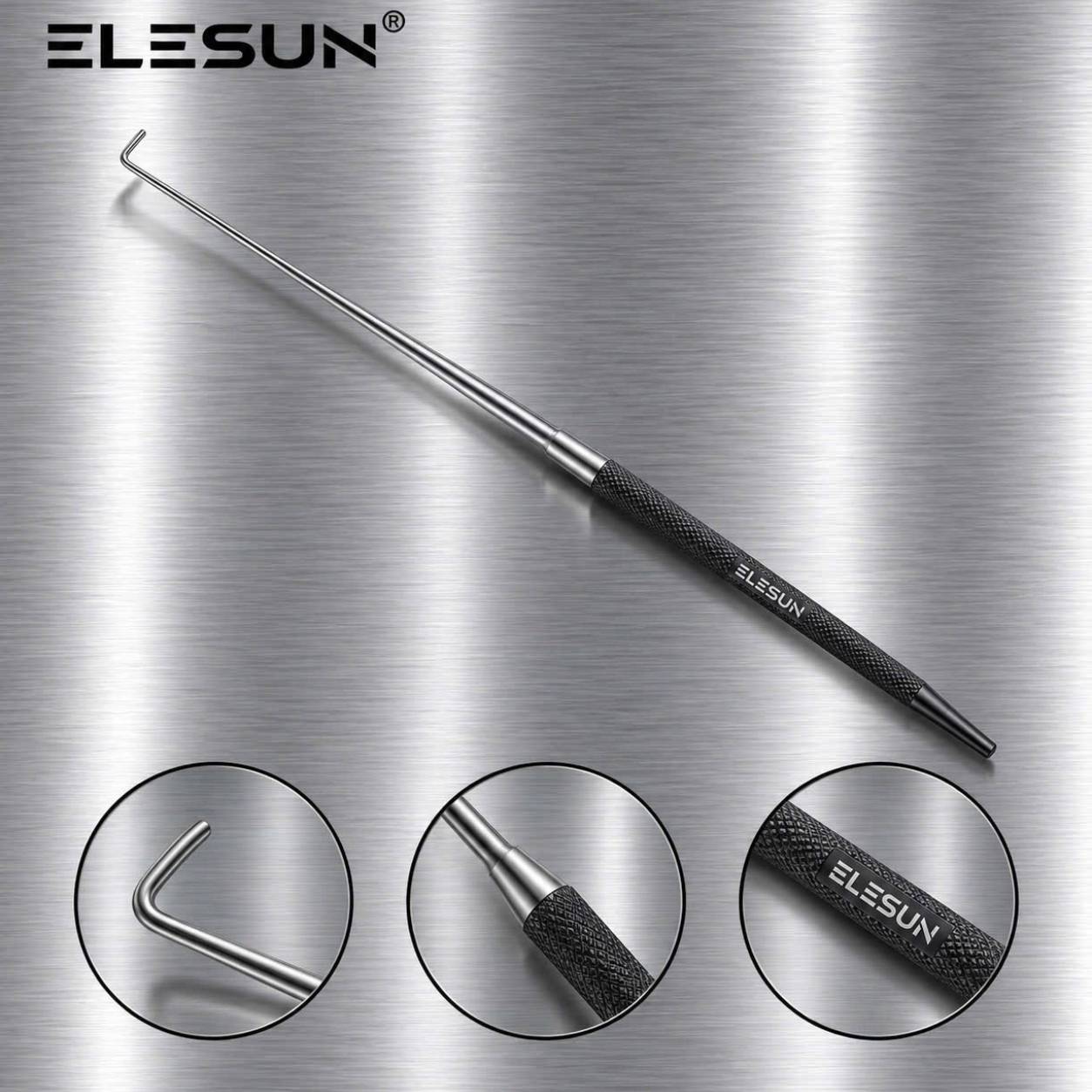
- Nerve Hook: A microsurgical instrument with a hook-shaped working end, including the right-angle nerve hook configuration described by Rhoton for structural exploration and orientation.
- Micro-Probe: "Probe" is used in current ELESUN product nomenclature for a micro-probe working-end configuration with a smooth, blunt profile designed for exploring anatomical recesses.
- Forceps: Active grasping instruments with dual spring-tension leaves, representing a distinct grasping and holding instrument class.
- Retractors: Instruments that maintain static operative field exposure, functionally distinct from handheld dynamic manipulation tools.
- Curettes: Instruments featuring cup-shaped or ring-shaped cutting edges for bone or cartilage removal, representing a separate scraping and debridement class.
2. Microsurgical Dissector Configurations & Working Ends
In microsurgical corridors, the geometry of the dissector working end determines mechanical contact with tissue planes. As described by Rhoton (2003, p. 919), spatula microdissectors represent a primary working-end configuration utilized for separating anatomical tissue planes under magnification.
Thin, planar spatula profiles facilitate separation along natural anatomical boundaries. Within the specialized product portfolio, the ELESUN Micro Neurosurgical Dissector & Probe Instrument Set incorporates assorted micro-spatulas and dedicated probes organized in a dedicated sterilization rack for neurosurgical interventions.
3. Nerve Hook & Probe Geometry
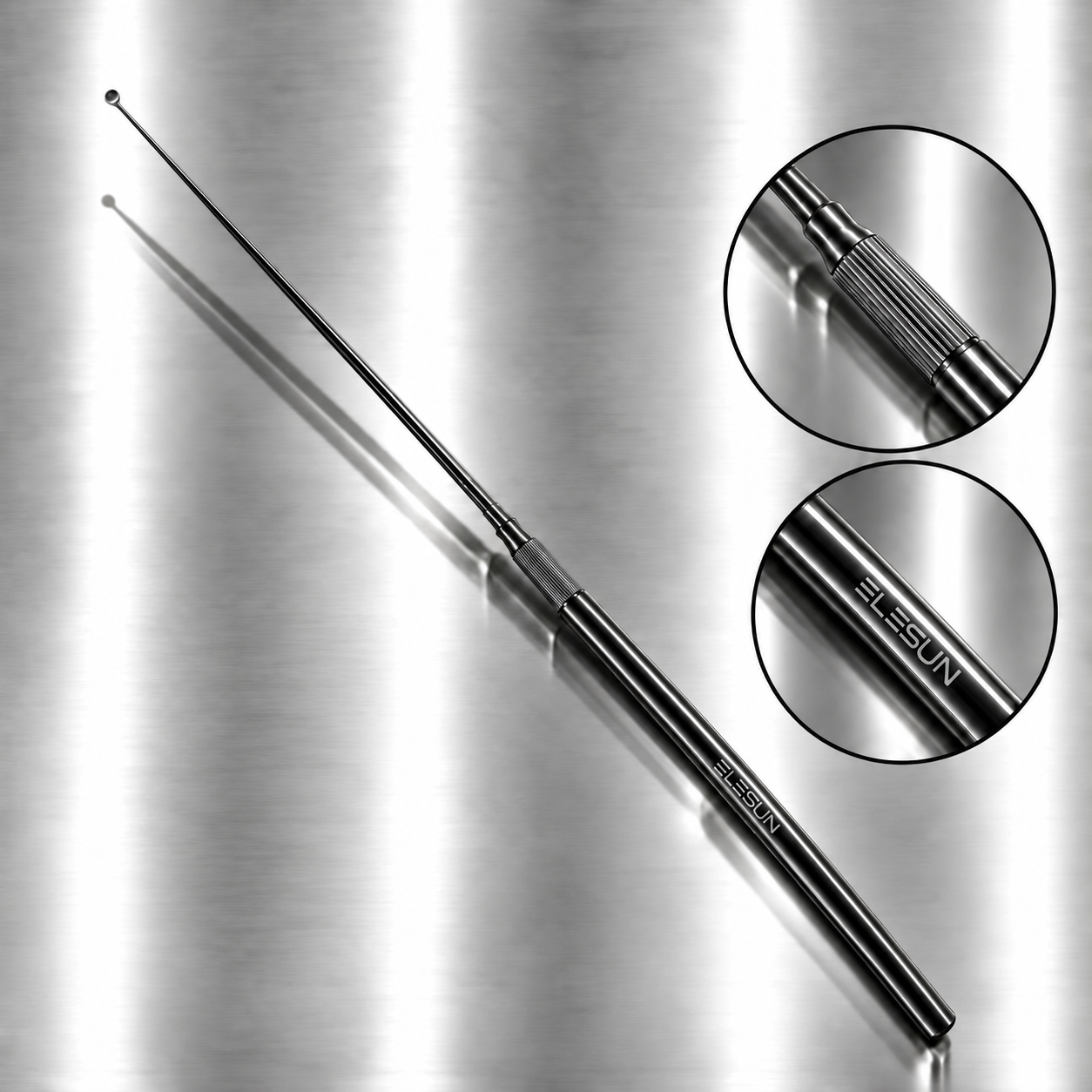
In addition to flat dissector spatulas, the right-angle nerve hook configuration is a specialized working-end geometry documented in Rhoton's microsurgical set (2003, p. 919). This geometry features a 90° bend with a smooth, blunt tip profile providing access for exploratory tactile manipulation.
In the ELESUN Micro Dural Dissector & Probe, the working end integrates a blunt 90° hook and micro-probe configuration, complemented by a satin matte anti-glare finish. The term "probe" in ELESUN catalog nomenclature denotes a slender working end designed for tactile exploration within narrow recesses.
4. Shaft, Handle & Instrument Orientation
The handling mechanics of microsurgical dissectors depend fundamentally on handle architecture and shaft alignment. Rhoton (2003, p. 919) emphasizes that cylindrical round handles permit surgeons to execute a subtle rolling motion between the thumb and index finger, creating axial rotation around the longitudinal axis.
From a kinematic perspective, Rhoton contrasts straight shafts with bayonet configurations: rotating a straight instrument keeps the working end stable on its central axis, whereas rotating a bayonet instrument sweeps the tip through a wide arc. Consequently, straight instruments are frequently selected when central tip stability during rotation is required. In ELESUN product models, knurled round handles provide surface texture for fingertip rolling manipulation.
5. Technical Evaluation & Selection Principles
Based on microneurosurgical instrumentation principles reviewed by Hernesniemi and colleagues (2005), instrument configuration should correspond directly with corridor depth and the physical demands of the anatomical site:
- Working Length: Instruments range from short to long to match operative corridor depth and reduce unwanted mechanical oscillation.
- Delicacy: Instruments range from sturdy to delicate based on structural tissue characteristics and surgical exposure constraints.
- Working-End Geometry: Selection between flat spatulas and right-angle hooks depends on whether tissue-plane separation or exploratory probing is required.
- Shaft Configuration: Straight shaft profiles are evaluated when central axis rotation stability is prioritized during manipulation.
Cleaning, disinfection, inspection, and sterilization should follow the applicable manufacturer's IFU and the healthcare facility's validated reprocessing procedures.
Frequently Asked Questions
What is the difference between a microsurgical dissector and a nerve hook?
Microsurgical dissectors and nerve hooks use different working-end geometries. Dissectors may use flat or spatula-shaped working ends, while nerve hooks use hook-shaped configurations. Selection should consider working-end geometry, working depth, and the specifications of the individual instrument model.
How does working-end geometry affect instrument selection?
Working-end geometry is an important technical evaluation criterion. Flat, spatula, hook, and probe configurations provide different mechanical contact profiles. Selection should follow the requirements and technical documentation of the specific instrument model rather than relying only on the general instrument-family name.
Which technical factors should be considered when evaluating a dissector or nerve hook?
Relevant factors may include instrument length, delicacy, shaft configuration, working-end geometry, and model-specific published specifications. For microsurgical instruments, these factors should be considered in relation to working depth and the requirements of the specialty instrument set.
What principles should be followed for cleaning and sterilization?
Cleaning, disinfection, inspection, and sterilization should follow the applicable manufacturer's IFU and the healthcare facility's validated reprocessing procedures. Reprocessing cycles, parameters, or chemicals should not be inferred from product images or general product descriptions.
References
- Rhoton AL Jr. (2003). Operative Techniques and Instrumentation for Neurosurgery. Neurosurgery, 53(4):907-934; discussion 934 (PMID: 14519224).
- Hernesniemi J, Niemelä M, Karatas A, Kivipelto L, Ishii K, Rinne J, Ronkainen A, Koivisto T, Kivisaari R, Shen H, Lehecka M, Frösen J, Piippo A, Jääskeläinen JE. (2005). Some collected principles of microneurosurgery: simple and fast, while preserving normal anatomy: a review. Surgical Neurology, 64(3):195-200 (PMID: 16099243).