
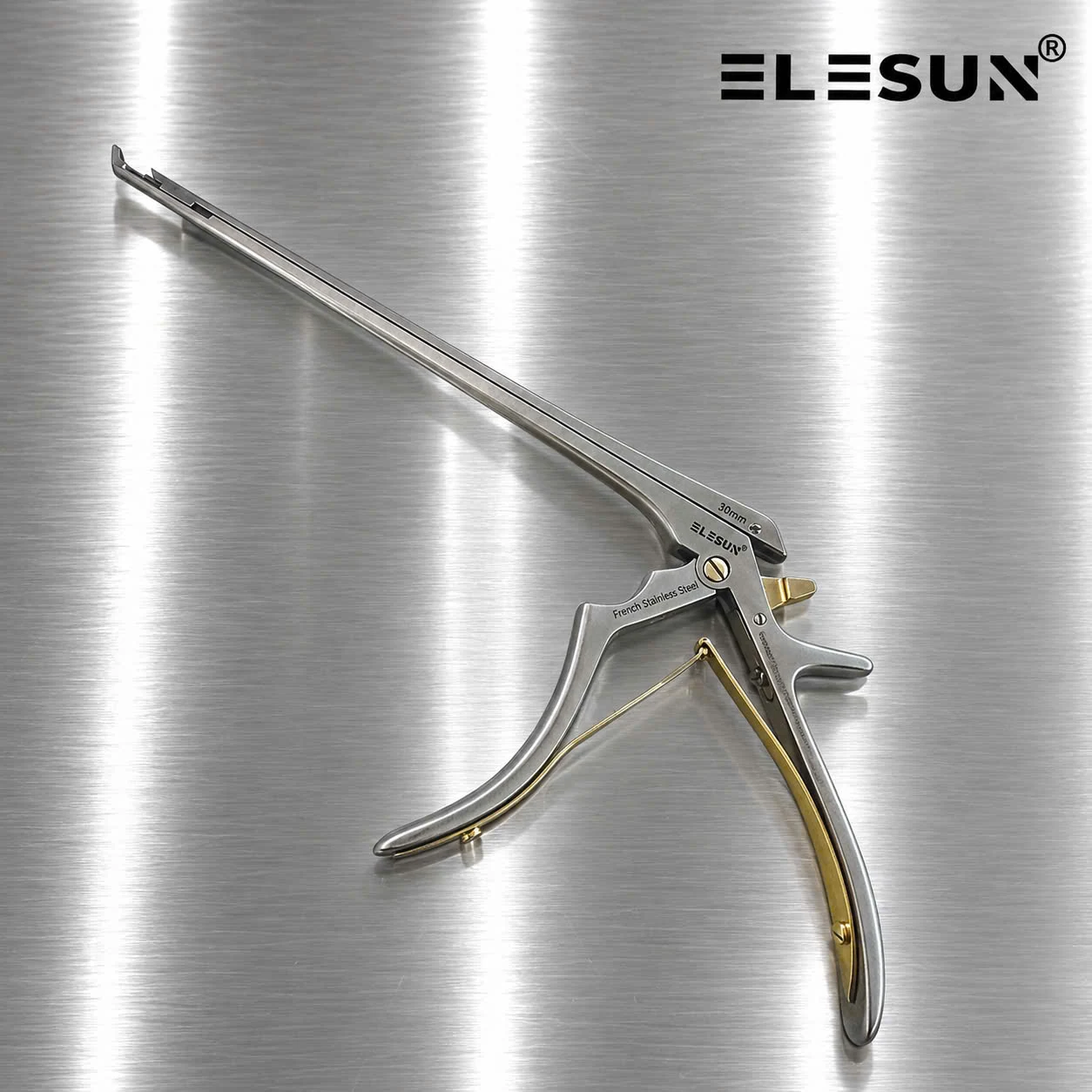
Comprehensive guide to the ELESUN Kerrison Rongeur: precision punch shearing mechanics, up-biting vs down-biting orientations, offset bayonet geometry, detachable architecture, and essential roles in spinal decompression.
Quick Answer (Answer-First):
The ELESUN Kerrison Rongeur is a precision mechanical bone-punch instrument in the neurosurgical & spine instruments ecosystem, engineered for controlled, incremental excision of bone and fibrous ligamentous structures within narrow operative corridors. It serves as an indispensable tool during spinal decompression workflows, including laminotomy, laminectomy, and foraminotomy. Available in up-biting, down-biting, offset bayonet configurations, and disassemblable detachable architectures that expose internal sliding tracks, the ELESUN Kerrison Rongeur maximizes intraoperative maneuverability while supporting rigorous mechanical inspection and reprocessing protocols per manufacturer instructions for use (IFU).
In spine surgery and neurosurgical intervention, working with rigid osseous tissue adjacent to neural structures presents an inherent mechanical challenge. As surgical exposure progresses into the epidural space, surgical teams require an instrument that reliably removes compressive bone or hypertrophied ligament while respecting delicate neural boundaries.
The ELESUN Kerrison Rongeur addresses this surgical requirement through high-precision sliding punch mechanics, translating grip actuation into a clean, localized guillotine bite along a micro-machined linear guide rail. By uniting an ultra-thin stationary protective footplate with an advancing cutting jaw, it delivers tactile responsiveness and uncompromised structural integrity throughout complex spinal decompression procedures.
1. What Is a Kerrison Rongeur?
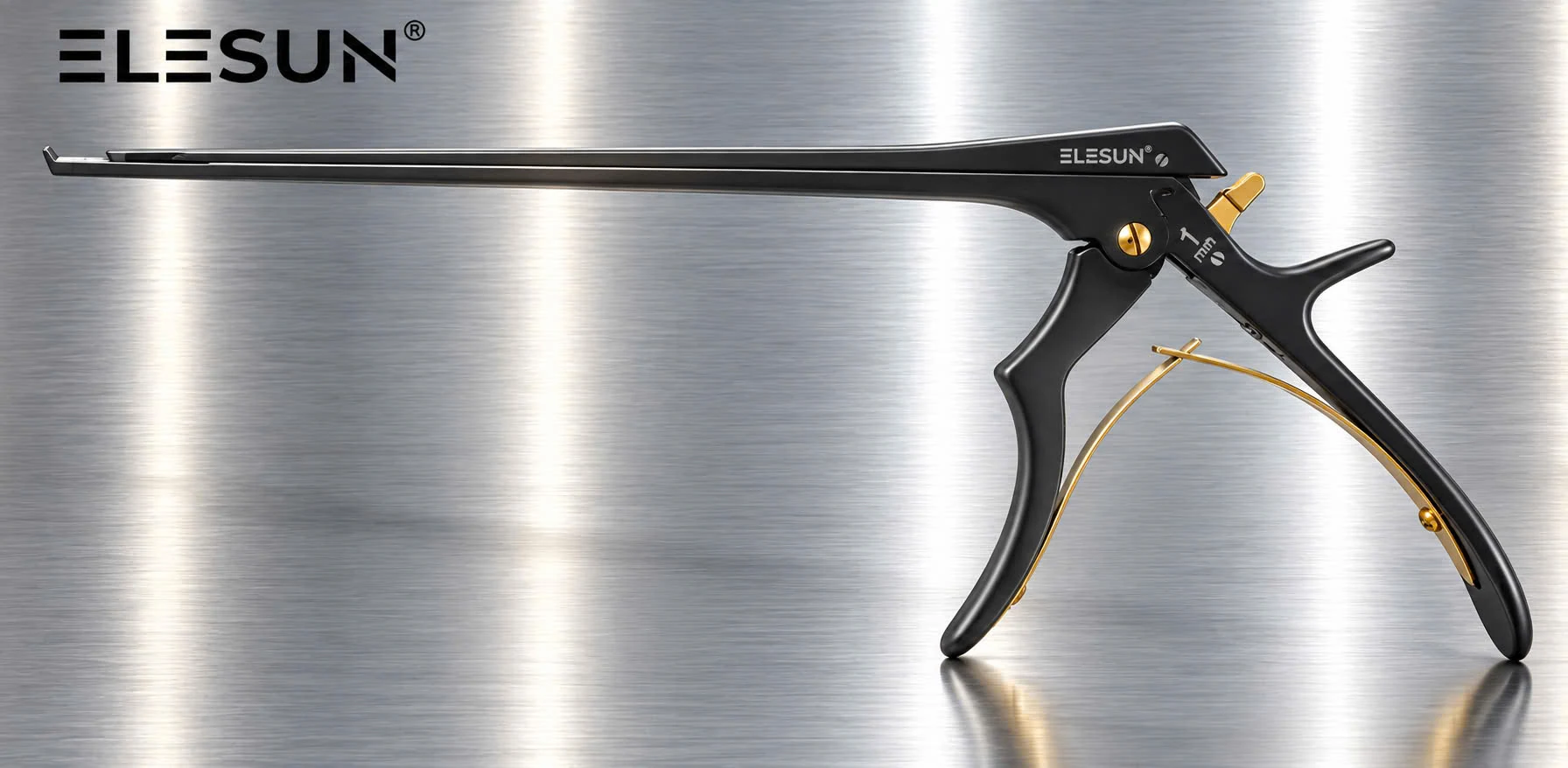
A Kerrison Rongeur (frequently designated as a Kerrison bone punch) is a specialized surgical instrument engineered for precise, incremental excision of dense cortical bone and hypertrophied soft tissues in constrained operative corridors. Within surgical instrument taxonomies, it is positioned directly within the bone-work and decompression instrument group.
The fundamental difference between a Kerrison Rongeur and dual-cup bone rongeurs (such as Luer or Ruskin patterns) lies in its sliding guillotine mechanism: a stationary, thin anvil footplate is introduced beneath the laminar ledge to serve as a cutting counter-face and dural barrier, while an upper cutting jaw glides forward along the shaft to shear the targeted bone cleanly against the internal anvil face.
This self-contained cutting dynamic isolates cutting stresses between the moving blade and the stationary footplate, preventing lateral torque or prying forces from transferring to delicate surrounding spinal cord or dural elements.
2. The Role of the Kerrison Rongeur in Spinal Decompression
During spinal decompression interventions, the Kerrison Rongeur acts as the primary instrument for creating space around neural elements by systematically resecting compressive osseous and ligamentous barriers. It serves across four primary procedural stages:
- Laminotomy and Laminectomy: Following high-speed burr cortical thinning, the Kerrison engages the lower margin of the vertebral lamina, removing precise bony bites to unroof the spinal canal without concussive impact.
- Ligamentum Flavum Resection: Hypertrophic ligamentum flavum is a frequent cause of central and lateral recess spinal stenosis. The Kerrison bites through thickened fibrous bands directly over the epidural interface along natural anatomical planes.
- Lateral Recess and Foraminal Decompression (Foraminotomy): The instrument extends laterally into the exit corridor of the nerve root, trimming osteophytes and undercutting superior articular processes to alleviate root impingement.
- Surgical Corridor Preparation: In lumbar discectomy, the Kerrison planes away impeding bone shelves before surgical grasp tools such as pituitary rongeurs are introduced into the intervertebral disc space.
3. Functional Architecture and Cutting Mechanics
The ELESUN Kerrison Rongeur is constructed from medical-grade surgical alloy, comprising three synchronized mechanical assemblies: the force-transmitting lever handle, the linear guide shaft, and the distal cutting punch jaw.
Lever Handle and Spring Return Mechanism
The ergonomic handle is engineered with a high mechanical advantage ratio, multiplying manual grip force at the distal cutting tip to effortlessly bite through sclerotic bone while mitigating surgeon hand fatigue during prolonged multilevel cases. A calibrated double leaf spring mechanism provides consistent elastic recoil, automatically restoring the jaws to an open position upon hand release.
Instrument Shaft and Precision Slide Rail
The shaft integrates a rigid lower support frame and an upper movable slide rail. The slide rail travels within micro-milled guide grooves designed with tight mechanical tolerances, eliminating lateral deflection or binding friction throughout linear actuation.
Stationary Footplate and Advancing Cutting Jaw
The working tip combines a stationary footplate and a hollow advancing punch blade. Upon handle compression, the slide rail drives the cutting jaw forward against the hardened anvil face, cleanly shearing bone fragments. The hollow jaw channel temporarily retains excised bone, facilitating removal from the operative field.
| Mechanical Component | Engineering Characteristics | Clinical Operative Function |
|---|---|---|
| Lever Handle Assembly | Ergonomic grip contours with mechanical force multiplication | Generates high cutting shear across dense bone while reducing hand fatigue |
| Leaf Spring Assembly | High-cycle elastic spring steel with robust pivot anchor | Smoothly restores the jaw to default open position after each bite |
| Precision Slide Rail | Upper rail fitted to grooved lower channel with micro-tolerances | Ensures true linear translation without play or binding during advancement |
| Stationary Footplate (Anvil) | Thin footplate profile with smooth polished dural-facing back | Acts as an immovable cutting counter-face while shielding neural tissue |
| Guillotine Cutting Jaw | Hardened razor-sharp perimeter with bone-holding recess | Excises bone cleanly and retains fragments for extraction outside the field |
4. What Is an Up-Biting Kerrison?
An up-biting Kerrison is configured such that the cutting jaw advances toward an upward-oriented footplate hook relative to the long axis of the instrument shaft. This configuration represents the standard and most frequently utilized bone-punch design in spinal neurosurgery.
In up-biting architecture, the smooth back of the stationary footplate rests against deep anatomical structures, while the active cutting jaw approaches from above and bites upward away from the spinal canal. When the surgeon actuates the lever, bone excision force vectors point upward toward the superficial operative wound according to the surgical pathway.
5. What Is a Down-Biting Kerrison?
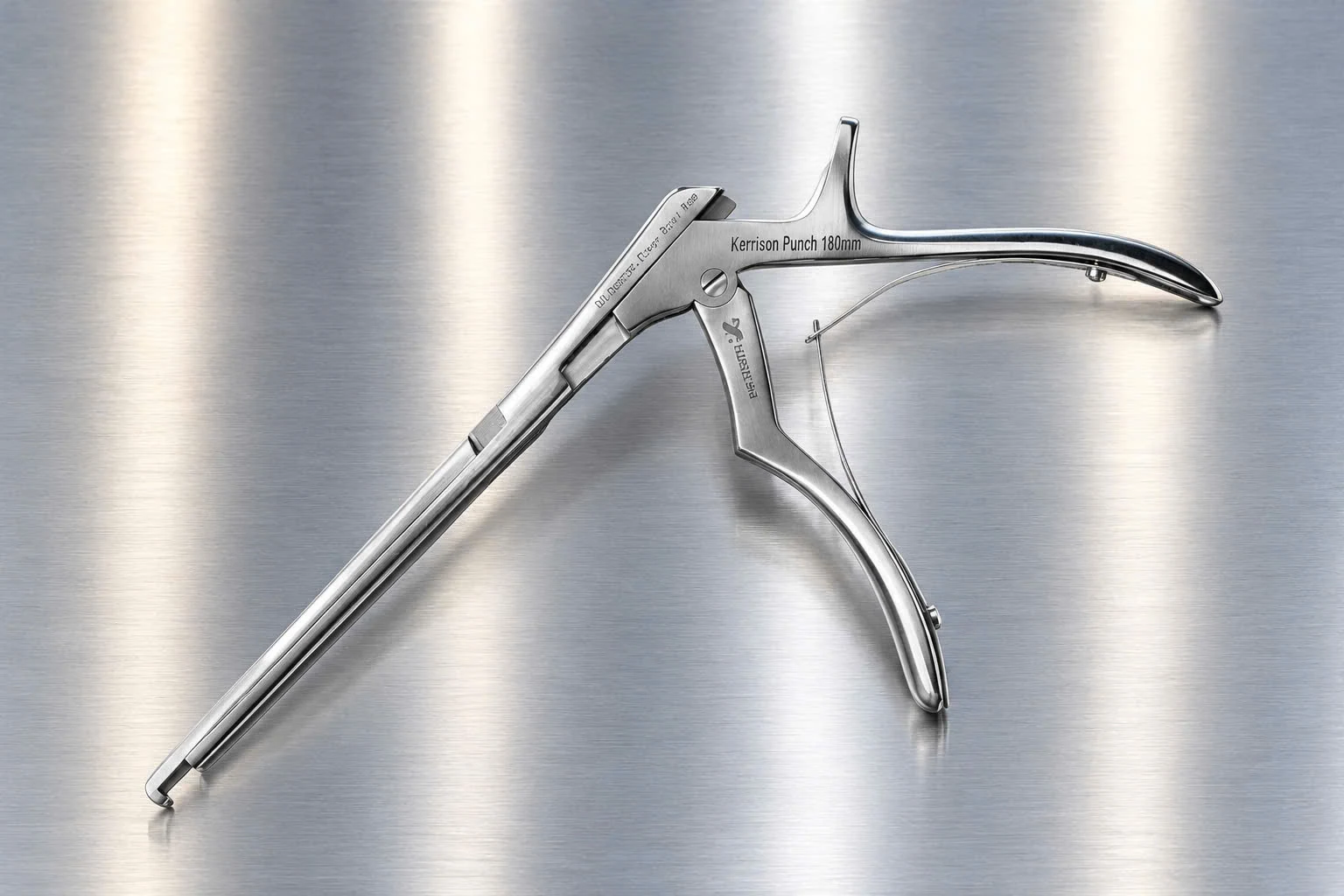
A down-biting Kerrison is engineered with an inverted jaw vector: the cutting blade glides toward a downward-facing footplate. This configuration is engineered to solve specific anatomical trajectory constraints where standard up-biting geometry cannot comfortably engage.
When decompressing the cranial lip of an exit foramen or undercutting superior bony overhangs under microscopic visualization, the line of sight requires a downward-directed approach. A down-biting instrument allows the surgeon to position the footplate along the superior ledge and execute a clean downward bite without requiring extreme wrist extension or awkward hand reorientation.
6. Comparison: Up-Biting vs. Down-Biting Kerrison
Both up-biting and down-biting configurations share identical mechanical precision and guillotine shear principles, serving complementary roles across procedural trajectories within complex spinal cases:
| Design Dimension | Up-Biting Kerrison | Down-Biting Kerrison |
|---|---|---|
| Cutting Vector Direction | Cutting jaw shears upward toward the superficial field | Cutting jaw shears downward toward the deep margin |
| Footplate Barrier Location | Footplate rests against underlying thecal/neural tissue | Footplate rests against superior/contralateral bone shelf |
| Primary Procedural Indications | Standard laminectomy, inferior laminar edge, spinous base | Superior foraminal notch, contralateral overhangs, facet undercut |
| Hand Ergonomics | Natural neutral wrist alignment in upright surgical corridor | Allows downward engagement without awkward wrist pronation |
7. What Is a Bayonet Kerrison Rongeur?
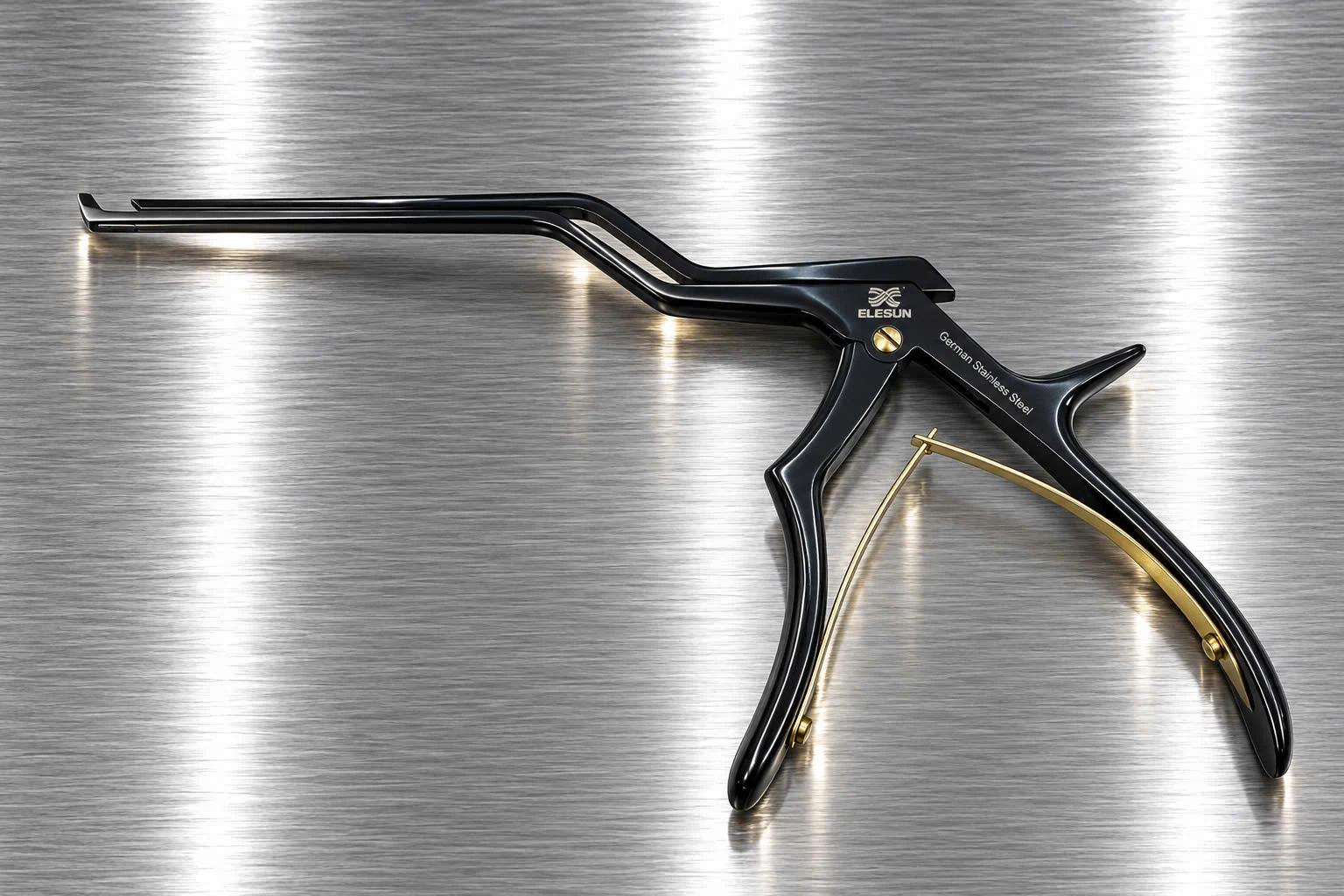
A bayonet Kerrison Rongeur (or bayonet-shaft Kerrison Rongeur) is a specialized spinal decompression instrument variant featuring an offset shaft profile that displaces the handle and proximal body away from the primary working axis. This access geometry helps reduce obstruction of the operator's line of sight and preserves direct optical visualization in deep, narrow surgical corridors beneath operating microscopes or surgical loupes.
Whereas conventional straight-shaft Kerrison rongeurs align the handle coaxially with the cutting tip—an arrangement well suited for direct open operative windows—the bayonet configuration provides distinct geometric clearance during minimally invasive procedures or tubular retractor approaches. Displacing the handle laterally and vertically ensures that ambient surgical illumination and microscopic viewing paths remain uncompromised by the surgeon's hand.
| Geometric Dimension | Straight Kerrison Architecture | Bayonet Kerrison Architecture (Offset) |
|---|---|---|
| Shaft Alignment | Linear coaxial trajectory from handle to cutting tip | Step-offset shaft displacing handle from operative axis |
| Line-of-Sight Access | Optimal for wide, direct open surgical exposures | Preserves direct visual corridor in deep, narrow operative channels |
| Corridor Geometry | Broad access corridors with unrestricted hand maneuverability | Constrained tubular retractor ports and microscopic pathways |
8. What Is a Detachable Kerrison Rongeur?
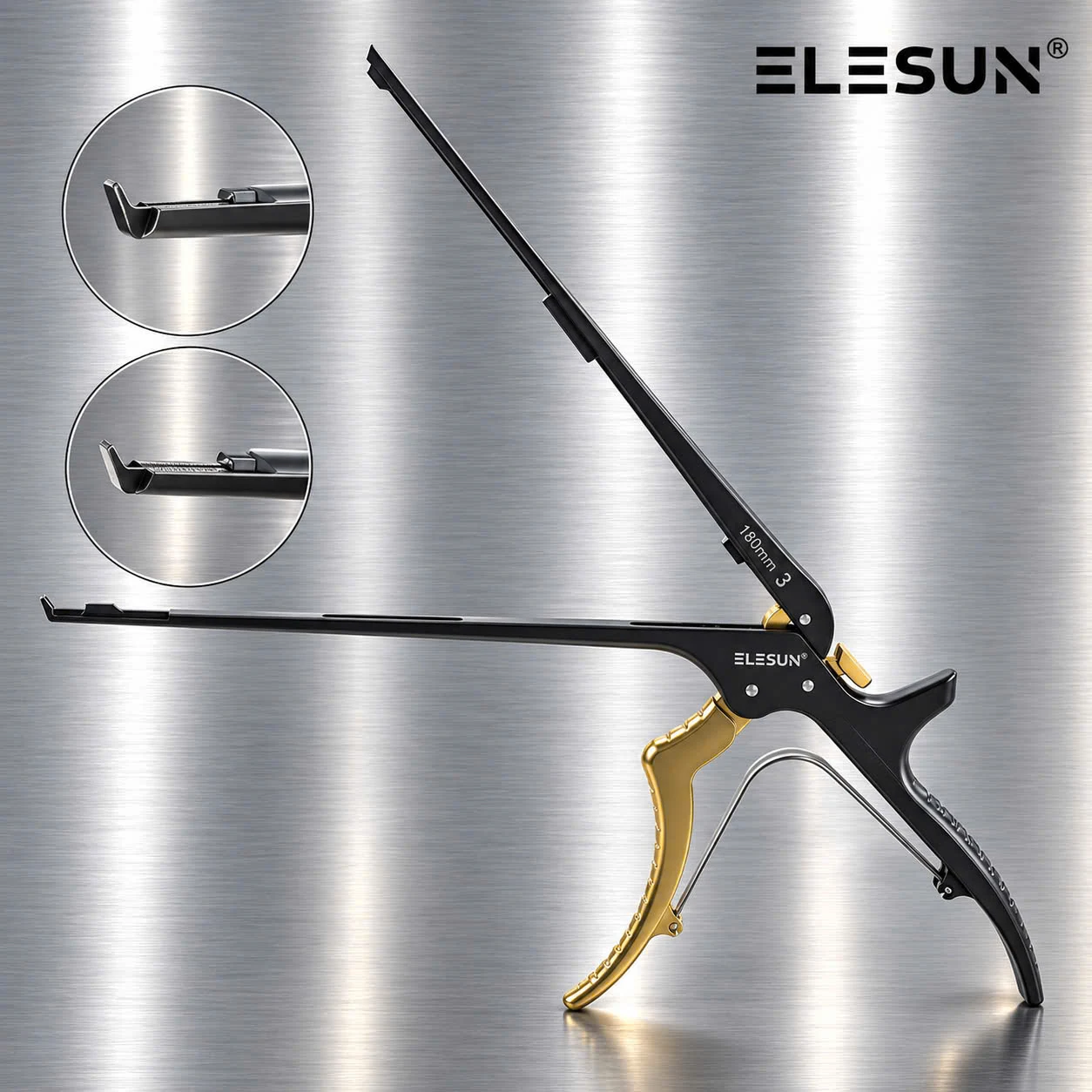
A detachable Kerrison Rongeur is an advanced surgical instrument design that permits the upper movable slide rail to pivot open or detach completely from the lower frame without requiring tools. This architecture eliminates the mechanical "blind channel" inherent in traditional fixed rongeurs.
In conventional fixed Kerrison instruments, the microscopic tolerance between the sliding rail and the guide channel can trap bone dust, clotted blood, and proteinaceous bioburden during extensive spinal surgery. Without the ability to expose the slide rail, manual scrubbing of internal sliding tracks is hindered, increasing the risk of mechanical friction and gradual bioburden buildup.
Detachable architecture exposes internal sliding surfaces, facilitating visual inspection for wear or misalignment and enabling Central Sterile Supply Departments (CSSD) to execute thorough physical cleaning in accordance with validated manufacturer IFUs.
9. Detachable Architecture and Internal Rail Accessibility
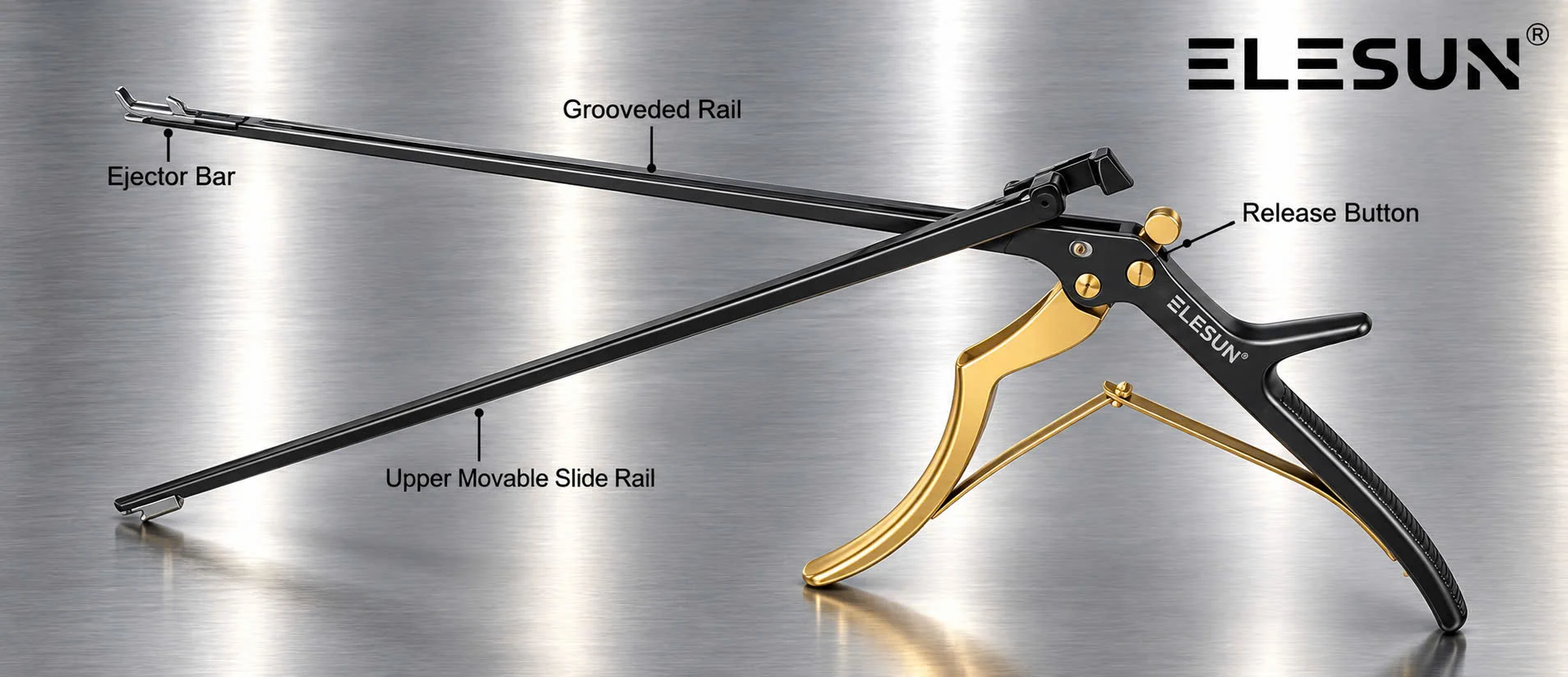
The disassemblable architecture of the ELESUN detachable Kerrison Rongeur incorporates four standardized mechanical elements engineered for effortless maintenance and durability:
- Release Button: A precision gold-accented mechanical button located at the main handle pivot, allowing operating room staff to unlock and release the upper slide rail with a single firm press.
- Upper Movable Slide Rail: The linear actuation arm carrying the cutting punch blade, engineered to pivot open to a wide angle or disengage entirely for inspection.
- Grooved Rail: The precision-milled guide track embedded within the lower shaft, designed for minimal friction and effortless flushing.
- Ejector Bar: An integrated tip mechanism that automatically expels severed bone plugs upon handle release, preventing tip jamming during rapid repetitive biting.
10. Fixed vs. Detachable Architecture: Key Differences
Evaluating fixed versus detachable Kerrison rongeurs balances traditional unitary simplicity against enhanced accessibility for hospital instrument reprocessing:
| Evaluation Dimension | Conventional Fixed Kerrison | Detachable Kerrison Architecture |
|---|---|---|
| Internal Track Visibility | Enclosed internal channels remain inaccessible to direct inspection | Pivoting rail exposes internal tracks for direct visual examination |
| CSSD Reprocessing Access | Relies on pressurized irrigation through narrow guide tolerances | Enables direct mechanical brush access across all internal mating faces |
| Mechanical Wear Detection | Wear is assessed indirectly via tactile gliding resistance | Permits direct inspection of guide rail surfaces for micro-scoring |
| Operational Handling | No disassembly steps required before or after the procedure | Requires adherence to release and relatching protocols per IFU |
| Structural Rigidity | Monolithic chassis provides solid baseline mechanical rigidity | Precision locking lugs deliver identical rigidity when latched |
11. Technical Selection Criteria for Kerrison Rongeurs
Configuring an optimal Kerrison instrument tray for neuro-spine surgical services in the ELESUN Neuro-Spine instruments portfolio involves systematic evaluation of clinical parameters:
- Footplate Profile Thickness: Thin footplate geometry is an essential selection factor when navigating constrained spaces between compressed neural margins and laminar bone.
- Punch Bite Dimension: Trays should encompass progressive bite widths from narrow micro-bites for delicate foraminal work up to wider widths for central laminectomy.
- Working Shaft Reach: Different working shaft lengths accommodate varying anatomical depths across cervical, thoracic, and lumbar interventions.
- Working Tip Orientation: Forward-angled and angled tip orientations provide clear visual corridors beneath operating microscopes and match varied anatomical approach angles.
- Tactile Feedback and Ergonomic Weight: Balanced weight distribution allows surgeons to accurately sense tissue density and execute controlled resection.
- Chassis Architecture (Fixed vs. Detachable): Selection should harmonize with hospital sterilization protocols and CSSD processing capabilities.
12. Mechanical Inspection and Reprocessing Protocols
Kerrison rongeurs endure repetitive mechanical shear stresses against dense bone, requiring systematic maintenance and reprocessing to preserve mechanical performance:
- Blade Edge and Anvil Inspection: Prior to each surgical procedure, inspect cutting margins under magnification. Dull or chipped blades chew bone rather than cutting cleanly, necessitating prompt maintenance.
- Smooth Gliding Verification: Actuate the handle manually through full travel. The slide rail must advance smoothly without sticky resistance or lateral play along the entire shaft length.
- Reprocessing and IFU Compliance: Detachable architecture can provide greater physical access to internal sliding surfaces for visual inspection and reprocessing. Cleaning, disinfection, and sterilization must follow the applicable ELESUN IFU and the healthcare facility's validated protocol.
Consult ELESUN Spine Instrumentation
Explore our comprehensive Kerrison Rongeur systems and surgical solutions supported by ELESUN technical specialists.
13. The Kerrison Rongeur in the ELESUN Neuro-Spine Ecosystem
Within the ELESUN neuro-spine portfolio, the ELESUN Kerrison Rongeur is not an isolated mechanical device. It is positioned at the central pivot of the bone work and decompression sequence, creating a seamless workflow transition:
Patient Stabilization → Surgical Exposure → Bone Resection with Kerrison → Microsurgical Dissection → Spine Instrumentation
Consistent surgical alloy metallurgy, precise mechanical tolerances, and ergonomic configurations across straight, bayonet, up-biting, down-biting, and detachable models ensure the ELESUN Kerrison Rongeur meets the exacting demands of modern neurosurgical and spine centers.
14. Frequently Asked Questions (FAQ)
What is a Kerrison Rongeur?
A Kerrison Rongeur (also termed a Kerrison bone punch) is a specialized surgical punching instrument utilized in neurosurgery and spine procedures, engineered for precise, incremental excision of bone and fibrous soft tissue within constrained corridors with high tactile control.
In which surgical procedures is the Kerrison Rongeur employed?
The Kerrison Rongeur is primarily deployed in spine interventions (such as laminectomy, laminotomy, and foraminotomy) and cranial procedures, serving to trim osseous margins and relieve pathological compression on nerve roots and the thecal sac.
What is the role of a Kerrison Rongeur in spinal decompression?
In spinal decompression workflows, the Kerrison executes selective resection of the lamina and thickened ligamentum flavum, expanding the spinal canal and neural foramina while the stationary lower footplate shields underlying tissues along the resection boundary.
What is an up-biting Kerrison?
An up-biting Kerrison is a configuration where the cutting blade advances upward toward the footplate hook. This orientation allows the footplate to rest against deep structures while cutting bone outward toward the surgical corridor.
What is a down-biting Kerrison?
A down-biting Kerrison features a cutting jaw configured to bite in a downward orientation. It is selected when anatomical trajectory or contralateral bony overhangs require downward cutting force that cannot be accommodated by standard up-biting geometry.
How do up-biting and down-biting Kerrisons differ?
The primary distinction lies in cutting jaw vector relative to the protective footplate. Up-biting cuts upward (the conventional choice for laminar resection), whereas down-biting shears downward to navigate challenging surgical angles or reverse laminar margins.
How does a bayonet Kerrison Rongeur differ from a straight-shaft design?
A bayonet Kerrison Rongeur features an offset shaft that displaces the handle and operator's grip away from the working axis, reducing visual obstruction in deep or narrow corridors. A straight-shaft Kerrison maintains coaxial alignment from the handle to the cutting tip, which is suited for direct, unobstructed surgical trajectories.
What is a detachable Kerrison Rongeur?
A detachable Kerrison Rongeur is an engineered design enabling the upper sliding rail to disengage or open without specialized tooling, exposing the internal slide mechanism and guide grooves for visual inspection and physical reprocessing access.
Why is detachable architecture significant for inspection and reprocessing?
Detachable construction provides direct physical access to internal mechanical tracks where bone debris, bioburden, and surgical fluids can accumulate during prolonged procedures, facilitating thorough manual inspection and cleaning per validated IFUs.
What criteria should be evaluated when selecting a Kerrison Rongeur?
Key technical criteria include cutting bite vector (up-biting vs. down-biting), footplate profile thickness, mechanical gliding smoothness, jaw sharpness, spring return resilience, working shaft reach, and fixed versus detachable architecture aligned with CSSD capabilities.
References
- Minimally Invasive Decompression in Lumbar Spinal Stenosis — JBJS Essential Surgical Techniques (PMC6132610).
- Less invasive and less technically demanding decompressive procedure for lumbar spinal stenosis—appropriate for general orthopaedic surgeons? — International Orthopaedics (PMC3014485).
- Multilevel Minimally Invasive Lumbar Decompression: Clinical Efficacy and Durability to 2 Years — International Journal of Spine Surgery (PMC8375705).