
Technical deep-dive on the ELESUN Mayfield Skull Clamp: three-point cranial fixation principles, operating table coupling chain, functional components, and surgical selection criteria.
Quick Summary (Answer-First):
The ELESUN Mayfield Skull Clamp is a specialized cranial stabilization system in neurosurgery engineered to achieve rigid patient cranial immobilization through three-point cranial fixation. Linking seamlessly from the skull clamp through an articulated swivel adaptor to the operating table base unit, the system serves as a foundational platform for craniotomies, high-magnification microsurgery, and stereotactic neuronavigation.
Within the broader spectrum of neurosurgical and spine surgical instruments, cranial stabilization is not an isolated peripheral accessory—it is an indispensable prerequisite for all complex microsurgical procedures. Meticulous tumor dissections, microvascular aneurysm clipping, and expanded craniotomies fundamentally require an entirely immobilized operative corridor.
The ELESUN Mayfield Skull Clamp delivers an engineered mechanical stabilization solution, offering dependable three-dimensional rigidity, uniform clamping force distribution, and a stable structural foundation for surgical specialists.
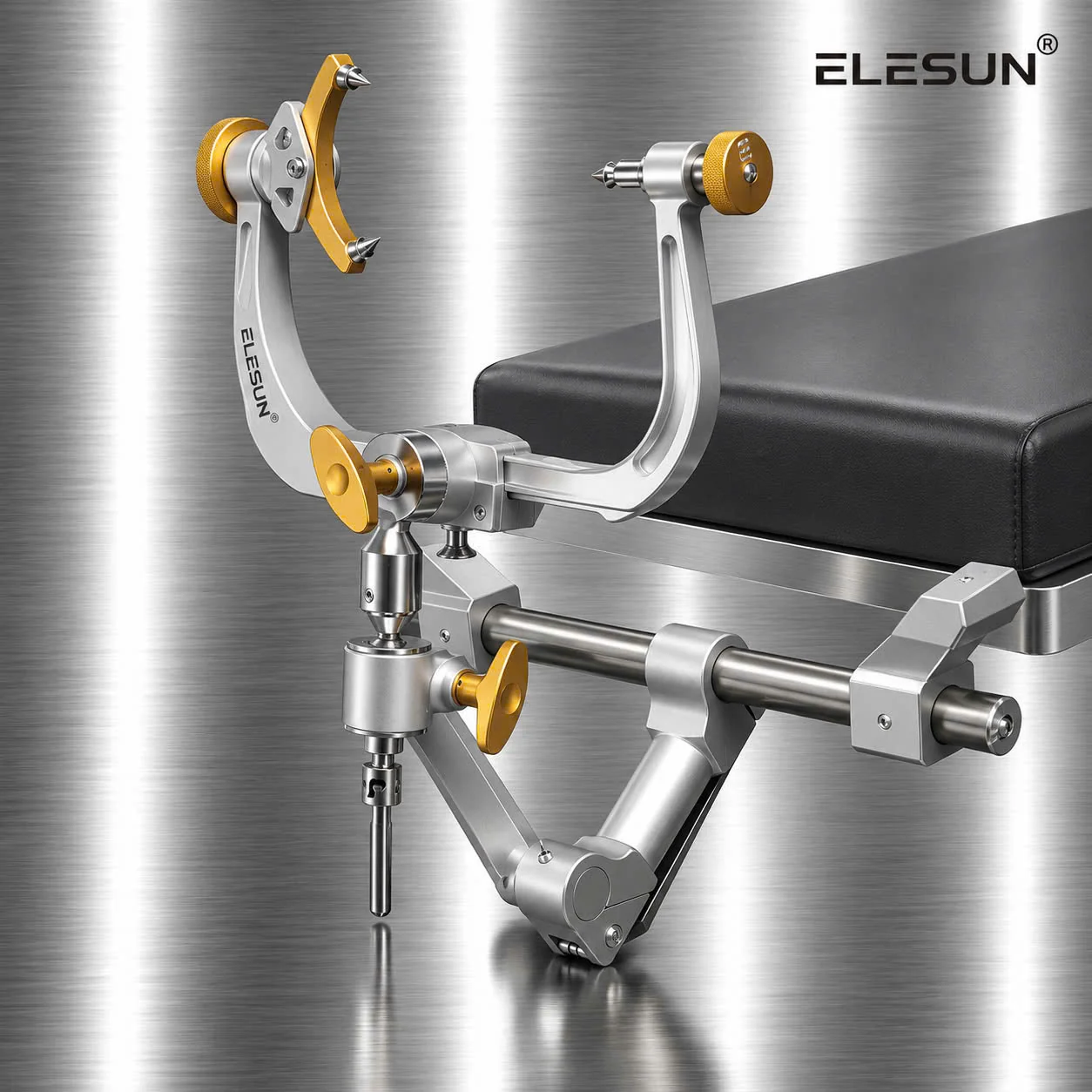
1. What Is the ELESUN Mayfield Skull Clamp?
The ELESUN Mayfield Skull Clamp is a specialized cranial stabilization system categorized within neurosurgical positioning instruments, designed to rigidly immobilize and hold the patient's cranium throughout surgical intervention. The apparatus connects directly to the surgical operating table via a multi-jointed transitional frame, facilitating precise patient head positioning across diverse surgical angles.
Unlike conventional soft head rests that only provide passive support against gravitational loads, the ELESUN Mayfield Skull Clamp establishes a rigid mechanical coupling directly into the calvarial bone using skull pins. Consequently, the patient's head remains completely immune to micro-movements caused by high-speed surgical drills, soft tissue retraction, or ventilator-induced respiratory excursions.
The ELESUN Mayfield cranial fixation system is extensively indicated for craniotomies addressing intracranial neoplasms, vascular malformations, posterior fossa exposures, skull base surgery, and procedures incorporating three-dimensional image guidance.
2. Mechanical Principles of Three-Point Cranial Fixation
The principle of three-point fixation represents the geometric and biomechanical cornerstone of the ELESUN Mayfield Skull Clamp's exceptional stability. In three-dimensional space, three non-collinear contact points constitute the exact mathematical condition required to define a single fixed plane, preventing linear translation and rotational slipping around any axis.
The system's three-point geometry is executed via an asymmetrical pin distribution across the two opposing arms of the skull clamp:
- Single-Pin Arm: Houses 1 cranial pin contacting one side of the skull, equipped with a torque-control drive screw and force adjustment mechanism.
- Two-Pin Rocker Arm: Houses 2 cranial pins mounted on a pivoting rocker assembly on the opposing arm. This rocker arm naturally self-aligns to the physiological curvature of the cranial vault, ensuring both pins seat uniformly against the calvarial surface.
As clamping force is dialed in, the three pins establish an equilibrium force triangle, seating securely into the outer cortical table of the skull. This design provides robust mechanical stability while eliminating concentrated stress points that could otherwise induce bone fractures or dural tears.
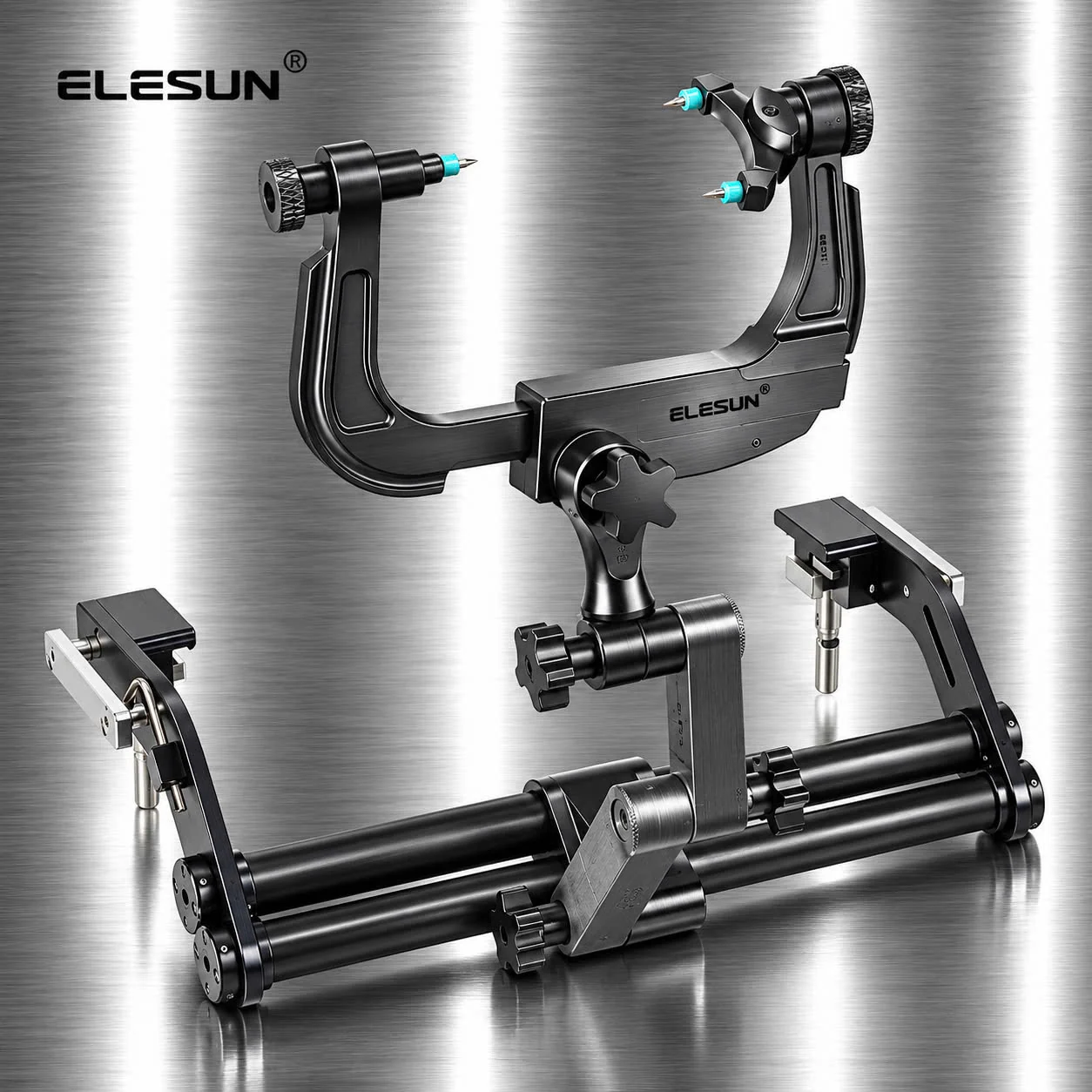
3. System Architecture & Operating Table Coupling Chain
The ELESUN Mayfield cranial fixation system constitutes a cohesive mechanical kinematic chain comprising distinct modular components linking the patient's cranium down to the structural side rails of the operating table. Each component handles specific kinematic freedoms, combining agile multi-planar adjustment with absolute locked rigidity.
The kinematic load-bearing chain comprises 4 core functional modules:
| Functional Module | Kinematic Position | Mechanical Function & Clinical Application |
|---|---|---|
| Skull Clamp Assembly | Distal cranial interface | Rigid C-frame encircling the cranium, carrying the single-pin and two-pin rocker assemblies, featuring sliding width adjustments and calibrated torque screw actuation. |
| Swivel Adaptor | Intermediate articulating joint | Multi-axis ball and radial joint featuring precision starburst interlocking teeth, enabling 360-degree rotation, pitch, and yaw alignment before locking rigidly. |
| Transitional Support Extension | Connecting extension body | Adjustable linkage arm bridging spatial clearances and height offsets between the patient's cranium and the surgical table across supine, prone, and lateral postures. |
| Base Unit Assembly | Structural foundation (table interface) | Heavy-duty dual mounting clamp securing directly to standard table side rails or head-end receptacles, bearing system load and bending moments without deflection. |
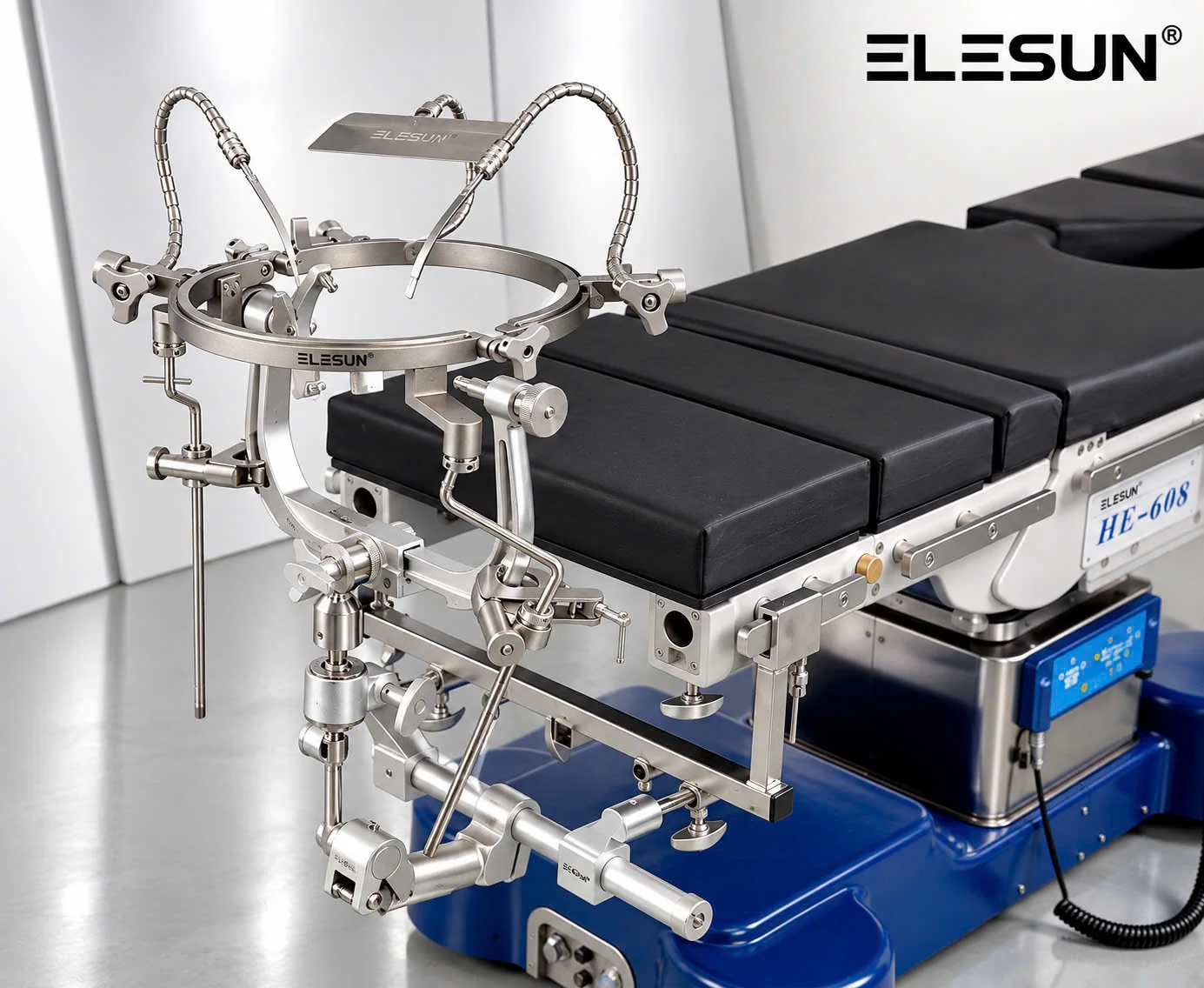
4. Role in Neurosurgical Operative Workflow
In standard cranial surgery, the ELESUN Mayfield Skull Clamp serves as the critical transition milestone between general anesthesia induction and active surgical access. The clinical application sequence proceeds systematically through 5 coordinated phases:
- Endotracheal intubation & patient transfer: Following induction of general anesthesia and secure airway management, the surgical team establishes preliminary head elevation and alignment.
- Clamp sizing & three-point pin engagement: The neurosurgeon identifies safe anatomical pin sites, adjusts the rocker arm to hug the skull contours, dials in calibrated clamping force, and verifies mechanical purchase.
- Coupling the articulated chain to the base unit: The surgical team adjusts the swivel adaptor and transitional linkages to achieve the target operative orientation (supine, lateral, prone, or park-bench), then locks all joints firmly.
- Neuronavigation registration & craniotomy: The optical or electromagnetic navigation reference frame is clamped directly onto the skull clamp body, followed by anatomical registration, surgical draping, incision, and bone flap elevation.
- Microsurgical resection & closure: Under stable magnification, surgeons deploy precision micro instruments such as Yasargil Titanium neurosurgical scissors, micro forceps, and aspiration tools with absolute confidence in field stillness.
5. Technical Selection Criteria for Cranial Fixation Systems
Procuring a cranial fixation system for neurosurgical departments requires an objective, multidisciplinary evaluation balancing structural rigidity, imaging compatibility, ergonomic versatility, and reprocessing endurance:
| Selection Criteria | Technical Parameter & Evaluation Focus | Clinical Significance |
|---|---|---|
| Mechanical Rigidity & Deflection Resistance | Structural resistance against multi-axis bending moments during bone milling, heavy drilling, and resting limb loads. | Prevents coordinate drift in neuronavigation and eliminates tremor under operative microscope magnification. |
| Metallurgy & Imaging Compatibility | Aeronautical aluminum alloys, surgical-grade stainless steel, or radiolucent carbon composite / titanium variants. | Optimizes weight-to-strength ratios, minimizes artifact formation during intraoperative CT/MRI where compatible models are selected. |
| Calibrated Torque Control & Indicators | Clearly marked mechanical force gauge or torque-limiting mechanism. | Enables precise force titration, mitigating skull depression in osteoporotic patients and preventing slippage from under-clamping. |
| Operating Table Interoperability | Universal mounting base compatible with standard US/European surgical table side rail widths and geometries. | Enables seamless interchangeability across diverse operating theaters without custom mechanical adaptors. |
| Reprocessing Ease & Joint Longevity | Toolless breakdown of articulating parts, corrosion-resistant passivated finishes, and resilience to repeated autoclave cycles. | Maintains starburst teeth sharpness, preserves thread smoothness, and safeguards against hospital-acquired cross-infection. |
6. Clinical Safety, Cleaning & Reprocessing Standards
Because cranial clamps incorporate intricate mechanical joints and establish invasive contact through the scalp into bone, strict adherence to reprocessing guidelines and safety protocols is paramount:
- Pin selection & placement safety: Inspect pin tips prior to every procedure for sharp conical geometry. Avoid placing pins over thin temporal squama, cranial sutures, prior burr holes, or major dural sinuses.
- Mandatory disassembly before decontamination: Disassemble rocker arms, pins, and swivel joints according to manufacturer IFU instructions to expose hidden threads and starburst serrations to enzymatic detergents.
- Neutral enzymatic cleaning: Use neutral-pH enzymatic solutions to prevent surface anodization damage or pitting corrosion. Employ non-abrasive nylon brushes on serrated surfaces.
- Validated steam sterilization: Execute steam autoclave sterilization in strict compliance with validated hospital cycles, ensuring all locking levers and knobs remain loosened to avoid internal thermal stress.
Neurosurgical Solutions by ELESUN
Explore our comprehensive neurosurgical instrument catalog and specialized operating room equipment supported by ELESUN technical specialists.
7. Frequently Asked Questions (FAQ)
What is the ELESUN Mayfield Skull Clamp?
The ELESUN Mayfield Skull Clamp is a specialized cranial stabilization system in neurosurgery designed to rigidly immobilize the patient's cranium in an optimal surgical position through three-point fixation linked directly to the operating table.
How does three-point cranial fixation work mechanically?
The system establishes a stable geometric plane in three dimensions using 3 cranial pin contact points: 1 single pin on one clamp arm and 2 pins on a rocker arm assembly on the opposing arm, distributing clamping force evenly and preventing rotational slippage.
How does the ELESUN Mayfield Skull Clamp integrate with the operating table?
The skull clamp couples to the operating table through an articulated kinematic chain comprising a swivel adaptor, transitional support arms, and a base unit anchored firmly to the table side rails, forming a rigid, vibration-free support structure.
How does the Mayfield Skull Clamp differ from standard head rests?
Standard head rests only provide passive support against gravity and allow micro-movements, making them unsuitable for high-magnification microsurgery. In contrast, the ELESUN Mayfield Skull Clamp provides rigid mechanical immobilization, maintaining absolute spatial coordinate stability for operative microscopes and neuronavigation systems.
What are the key clinical considerations for cranial pins?
Cranial pins must engage the outer cortex of the skull while strictly avoiding anatomical hazard zones such as cranial sutures, thin temporal bone regions, dural venous sinuses, or open fontanelles in pediatric patients. Dedicated pins must be selected in strict compliance with manufacturer IFU.
Can neuronavigation reference frames mount to the ELESUN Mayfield Skull Clamp?
Yes. In modern neurosurgery, the optical or electromagnetic reference frame is rigidly clamped directly onto the skull clamp body. The mechanical rigidity of the skull clamp is therefore vital for maintaining millimeter-level neuronavigation spatial accuracy throughout surgery.
What are the essential reprocessing and maintenance protocols?
All articulated joints, torque mechanisms, threads, and locking assemblies must be disassembled according to IFU instructions, thoroughly cleaned of organic bioburden, inspected for mechanical fatigue or corrosion, appropriately lubricated with surgical-grade lubricants where specified, and sterilized according to validated hospital cycles.
Professional Notice & Disclaimer
This technical article is intended exclusively for educational and informational purposes regarding neurosurgical device architecture. Specific pin placement, calibrated clamping force titration, and reprocessing regimens must strictly follow manufacturer Instructions for Use (IFU) and institutional clinical guidelines.